
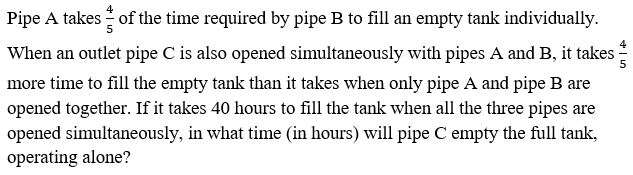
Pipe A takes 4⁄5 of the time required by pipe B to fill an empty tank individually. When an outlet pipe C is also opened simultaneously with pipes A and B, it takes 4⁄5 more time to fill the empty tank than it takes when only pipe A and pipe B are opened together. If it takes 40 hours to fill the tank when all the three pipes are opened simultaneously, in what time (in hours) will pipe C empty the full tank, operating alone?
- (a)45
- (b)75
- (c)65
- (d)50
Answer
Why
Correct — D. The stem is an image: A takes 4⁄5 of B's time, adding outlet C makes the fill take 4⁄5 more time than A and B alone, all three together take 40 hours, and C alone has to be timed.
Let B alone take b hours, so A takes 4b⁄5 hours.
Rate of A and B = 5⁄(4b) + 1⁄b = 9⁄(4b)
Time for A and B = 4b⁄9 hours
4⁄5 more time multiplies that by 9⁄5:
(4b⁄9) × (9⁄5) = 4b⁄5 hours, and this is the given 40
4b⁄5 = 40 → b = 50, so B alone takes 50 h and A alone 40 h.
Subtract the rates:
C's rate = (rate of A and B) − (rate of all three)
= 9⁄200 − 1⁄40 = 9⁄200 − 5⁄200 = 4⁄200 = 1⁄50
C alone empties the full tank in 50 hours → option (d)
Why the others are wrong
- (a)45 — If C emptied in 45 hours the three together would fill at 9⁄200 − 1⁄45 = 41⁄1800, taking about 43.9 hours. The stem fixes that time at 40, so a 45-hour outlet drains too little.
- (b)75 — 75 hours makes C far too weak: 9⁄200 − 1⁄75 = 19⁄600, a fill time of about 31.6 hours. A slower outlet means a faster fill, so this pushes the answer the wrong way.
- (c)65 — At 65 hours the net rate is 9⁄200 − 1⁄65 = 385⁄13000, giving a fill of about 33.8 hours. Reaching exactly 40 hours needs the outlet to remove 4⁄200 of the tank an hour, which is 1⁄50.
Concept
Pipe sums are rate sums. A filling pipe adds 1⁄(its time) each hour, an outlet subtracts its own 1⁄(its time), and what fills the tank is the net rate.
This stem hides both times behind ratios. A takes 4⁄5 of B's time, which makes A the faster pipe, not the slower one.
And the outlet stretches the fill by 4⁄5 more time, so the new time is 1 + 4⁄5 = 9⁄5 of the old one — not 4⁄5 of it.
That second phrase is where the sum is won or lost. Read 4⁄5 more as a shortening and every step afterwards runs backwards.
The numbers land oddly neatly: A alone takes 40 hours and all three together also take 40 hours. That is not a coincidence to memorise but a check worth making — C at 1⁄50 exactly cancels B at 1⁄50, leaving A working on its own.
Key facts
- An outlet pipe is a negative rate, so the net filling rate is the sum of the inlet rates minus the outlet rate.
- Taking 4⁄5 more time means the new time is 9⁄5 of the old time, not 4⁄5 of it.
- Here A alone takes 40 hours, B alone 50 hours, and A with B 200⁄9 hours.
- C alone empties in 50 hours, a rate of 1⁄50 that exactly cancels B's 1⁄50.
Study next
Common traps
- Reading 4⁄5 more time as a time of 4⁄5, which shortens the fill instead of lengthening it.
- Taking A's time as 5⁄4 of B's because A is named first in the sentence.
- Adding C's rate rather than subtracting it, when C empties the tank.
The plain version of this sum hands you the pipe times outright — on 25 Sep 2024, 09:00, Quant Q.17 an inlet fills in 11 hours and an outlet empties in 15, and the work is one subtraction. Here the times are buried in fractions first, which is the harder version of the same rate arithmetic.
Related PYQs
No directly related past PYQ was found.