
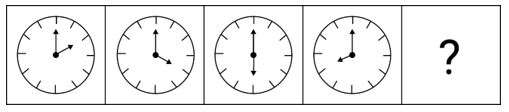
Select the figure from among the given options that can replace the question mark (?) and logically complete the series.
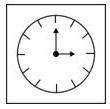
- (a)
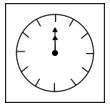
- (b)
- (c)
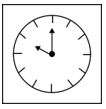
- (d)
Answer
Why
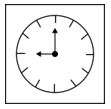
Correct — C. Rule: one arrow stays fixed at 12 o'clock while the second arrow turns 2 hour-marks, or 60 degrees, clockwise at each step.
Dial 1: the moving arrow points to 2 o'clock
Dial 2: to 4 o'clock
Dial 3: to 6 o'clock, straight down
Dial 4: to 8 o'clock
The fifth dial therefore shows the moving arrow at 10 o'clock, up and to the left, with the fixed arrow still standing at 12 — option (c).
Why the others are wrong
- (a)Option (a) puts the moving arrow at 3 o'clock, horizontally to the right. That is behind the series, which had already carried the arrow past 6 to 8.
- (b)Option (b) has both arrows at 12 o'clock. That is a turn of 4 hour-marks from dial 4, twice the step the series uses.
- (d)Option (d) points the moving arrow at 9 o'clock, horizontally to the left — one hour-mark short of the 10 o'clock a 2-mark step reaches.
Concept
Clock-face figures look like dial reading and are really rotation series. Fix on what does not move, then measure what does.
The long arrow sits at 12 in all four dials, so it is a reference line and not part of the pattern. The short arrow advances 2 hour-marks each step, and since each mark is 30 degrees, the rotation is 60 degrees clockwise per figure.
Counting in hour-marks beats counting in degrees here, because the dial prints twelve ticks you can count off with a finger.
The dial carries ticks but no numerals, and both lines end in arrowheads rather than in a long hand and a short hand. Treat it as a rotating figure, not as a clock showing a time.
Key facts
- Each tick on a twelve-mark dial is 30 degrees, so a two-mark step is 60 degrees.
- The arrow fixed at 12 is a reference line, and the whole pattern lives in the second arrow.
- The moving arrow runs 2, 4, 6, 8 and then 10 o'clock.
Study next
Common traps
- Reading the dials as clock times and trying to fit a run of hours and minutes.
- Measuring the rotation from the arrow that never moves.
- Choosing 9 o'clock because it is the next horizontal position, which ignores the 2-mark step.
The identical instruction runs at 9 Sep 2024, 12:30, Reasoning Q.8. The same task under different wording appears at 10 Sep 2024, 12:30, Reasoning Q.11 and at 11 Sep 2024, 09:00, Reasoning Q.5.
Related PYQs
No directly related past PYQ was found.