
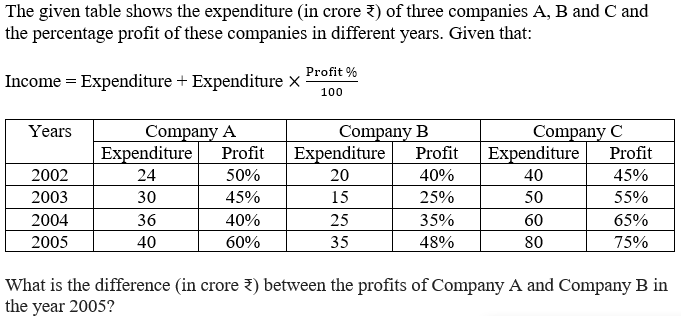
The given table shows the expenditure (in crore ₹) of three companies A, B and C and the percentage profit of these companies in different years. Given that: Income = Expenditure + Expenditure × (Profit % ⁄ 100) Years → Company A Expenditure | Company A Profit | Company B Expenditure | Company B Profit | Company C Expenditure | Company C Profit 2002 — 24 | 50% | 20 | 40% | 40 | 45% 2003 — 30 | 45% | 15 | 25% | 50 | 55% 2004 — 36 | 40% | 25 | 35% | 60 | 65% 2005 — 40 | 60% | 35 | 48% | 80 | 75% What is the difference (in crore ₹) between the profits of Company A and Company B in the year 2005?
- (a)10.4
- (b)8.3
- (c)12.5
- (d)7.2
Answer
Why
Correct — D. The table gives expenditure in crore ₹ and profit as a per cent of that expenditure, so profit = expenditure × profit% ÷ 100.
Company A, 2005: expenditure 40, profit 60%
= 40 × 60/100 = ₹24 crore
Company B, 2005: expenditure 35, profit 48%
= 35 × 48/100 = ₹16.8 crore
Difference = 24 − 16.8 = ₹7.2 crore → option (d)
Why the others are wrong
- (a)10.4 — 10.4 would need Company B's profit to be ₹13.6 crore, which is 38.9% of its ₹35 crore expenditure. The 2005 row states 48%.
- (b)8.3 — 8.3 would need B's profit at ₹15.7 crore. 48% of ₹35 crore is ₹16.8 crore, and 24 − 16.8 lands exactly on 7.2.
- (c)12.5 — 12.5 cannot come out of the profit amounts, which are ₹24 crore and ₹16.8 crore. The 60% and the 48% sit on different bases, ₹40 crore and ₹35 crore, so the 12-point gap between the rates is not the rupee gap.
Concept
The table is deliberately mixed: expenditure is an amount in crore ₹, profit is a rate. A profit percentage is worth nothing until you attach it to its own expenditure.
The stem defines income = expenditure + expenditure × profit%/100, which is the same as saying profit amount = expenditure × profit% ÷ 100.
That is why a higher rate need not mean a higher amount. Company C's 75% in 2005 rides on ₹80 crore and is worth ₹60 crore, while A's 60% rides on only ₹40 crore.
Read the year before you read the columns. The 2004 row — A at 36 and 40%, B at 25 and 35% — gives ₹14.4 crore against ₹8.75 crore, a completely different gap.
Key facts
- Profit amount = expenditure × profit% ÷ 100, from the income relation printed above the table.
- In 2005 Company A's profit is 40 × 60% = ₹24 crore and Company B's is 35 × 48% = ₹16.8 crore.
- The difference is ₹7.2 crore, which is not the same thing as the 12-point gap between 60% and 48%.
Study next
Common traps
- Subtracting the two profit rates (60 − 48 = 12) and reporting the gap in crore
- Subtracting the two expenditures (40 − 35 = 5) instead of the two profit amounts
Read the definition printed above the table before the table itself: here it is what turns a profit rate into a rupee amount.
Tables of plain amounts appear at 25 Sep 2024, 12:30, Quant Q.25 (a person's income per year) and 18 Sep 2024, 09:00, Quant Q.1 (a company's expenditure per year), where the question wants an average and no rate has to be converted.
Related PYQs
No directly related past PYQ was found.