
Select the figure from among the given options that can replace the question mark (?) in the following series.

- (a)
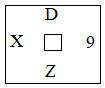
- (b)
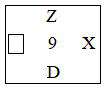
- (c)
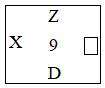
- (d)
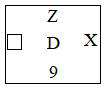
Answer
Why
Correct — D. Each box holds X, Z, 9, D and a small empty square in a cross: one at the top, three across the middle, one at the bottom.
Rule: one line of three shifts one place per step, and the axis alternates row, column, row, column.
Row items move right, column items move down, and the end item wraps round.
1 → 2, row: Z, square, 9 becomes 9, Z, square.
2 → 3, column: X, Z, D becomes D, X, Z.
3 → 4, row: 9, X, square becomes square, 9, X.
So 4 → 5 is a column step: D, 9, Z becomes Z, D, 9, with the square still on the left and X on the right → option (d).
Why the others are wrong
- (a)Option (a) shifts the row a second time — square, 9, X becomes X, square, 9 — while D and Z hold the top and bottom. Figure 3 to 4 was already a row step, and the axis alternates.
- (b)Option (b) merely swaps top with bottom, D against Z, and leaves 9 sitting in the centre. A column step moves all three cells, so the centre item has to change.
- (c)Option (c) turns the whole cross through 180 degrees, swapping top with bottom and left with right at once. Each step here moves one line of three and leaves the other pair alone.
Concept
A figure series of this kind is a permutation puzzle in disguise. Nothing is drawn, rotated or shaded — the same five items simply move between five fixed cells, so the work is to describe the movement precisely enough to apply it one more time.
Two habits make that quick. Name the cells (top, left, centre, right, bottom) and write each figure out as a list of five entries.
Then ask which items did not move. The pair that stayed still tells you which line of three did the shifting, and therefore which line is due to shift next.
The small empty square is an item like any other here, not a placeholder or a marker for a missing symbol. It occupies a cell and travels with everything else.
Key facts
- Figures 1 and 2 differ only in the middle row, where Z, square, 9 becomes 9, Z, square.
- Figures 2 and 3 differ only in the column, where X, Z, D becomes D, X, Z.
- The pair of cells that does not change between two figures identifies the axis of that step.
Study next
Common traps
- Repeating the axis of the previous step instead of alternating to the other one.
- Swapping the two ends of a line and leaving its centre alone, which moves two items rather than three.
- Rotating the whole figure when the rule moves one line at a time.
The same alternating one-line shift decides Reasoning Q.13 of the 24 Sep 2024, 09:00 paper, where a trio rides a vertical line while the corner pair walks a separate loop.
Related PYQs
No directly related past PYQ was found.