
If sec θ = √2, then cosec θ is equal to:
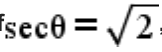
- (a)√2
- (b)1
- (c)0
- (d)−1
Answer
Why
Correct — A. The stem gives sec θ = √2 and asks for cosec θ. Walk between them on the Pythagorean identities.
sec²θ = 2, so tan²θ = sec²θ − 1 = 1
hence cot²θ = 1
cosec²θ = 1 + cot²θ = 1 + 1 = 2
cosec θ = √2 → option (a)
Angle route, same answer:
sec θ = √2 → cos θ = 1/√2
θ = 45°, and cosec 45° = √2
Why the others are wrong
- (b)1 — 1 is the value of tan 45° and cot 45°, not of cosec 45°. For cosec θ to be 1 you would need sin θ = 1 at θ = 90°, where sec θ is undefined rather than √2.
- (c)0 — 0 is impossible for a cosecant at all: cosec θ = 1/sin θ, and a reciprocal is never zero. Its magnitude is always at least 1.
- (d)−1 — −1 is wrong in sign and in size. cosec θ = −1 needs sin θ = −1 at θ = 270°, where cos θ = 0 and sec θ does not exist, so it cannot equal √2.
Concept
Both identities you need fall out of sin²θ + cos²θ = 1:
1 + tan²θ = sec²θ
1 + cot²θ = cosec²θ
Given one ratio, move along that chain to any other instead of hunting for the angle. Here sec²θ = 2 gives tan²θ = 1, hence cot²θ = 1, hence cosec²θ = 2.
The angle route works here only because √2 is a standard value. The identity route keeps working when the angle is not 0°, 30°, 45°, 60° or 90°.
The stem prints its maths as two images — the condition sec θ = √2 in the first, the expression cosec θ in the second. The text around them reads only 'If , then is equal to:', so a copy that loses the images loses the question.
Key facts
- sec θ = √2 means cos θ = 1/√2, which for an acute angle is θ = 45°.
- 1 + tan²θ = sec²θ and 1 + cot²θ = cosec²θ, both rearrangements of sin²θ + cos²θ = 1.
- At θ = 45°: sin = cos = 1/√2, sec = cosec = √2, tan = cot = 1.
Study next
Common traps
- Reading the second image as tan θ or cot θ and answering 1
- Taking the negative square root of cosec²θ = 2 when the standard-angle setting makes it positive
Given one ratio, SSC asks for another, or gives you a whole expression to collapse with the same two identities.
Also asked 25 Sep 2024, 09:00, Quant Q.1, which evaluates (cosec θ − sin θ)(sec θ − cos θ)(tan θ + cot θ), and 25 Sep 2024, 16:00, Quant Q.14, which wants sin θ given sec θ + tan θ = x.
Related PYQs
No directly related past PYQ was found.