
Samreen sells a keyboard for ₹1,260 at a profit of 25%, and another keyboard for ₹1,440 at a loss of 10%. What is her total gain or loss percentage?
- (a)

- (b)
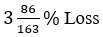
- (c)
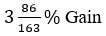
- (d)

Answer
Why
Correct — C. Two independent sales, so recover each cost price and then compare totals. Percentages on different cost prices cannot be added or averaged.
First keyboard: CP = 1260 ÷ 1.25 = ₹1,008
Second keyboard: CP = 1440 ÷ 0.90 = ₹1,600
Total CP = 1008 + 1600 = ₹2,608
Total SP = 1260 + 1440 = ₹2,700
Gain = 2700 − 2608 = ₹92
Gain % = (92 ÷ 2608) × 100
= 9200⁄2608
= 575⁄163
= 3 86⁄163 % gain → option (c), the image reading 3 86⁄163 % Gain.
Why the others are wrong
- (a)Two errors at once. The total selling price ₹2,700 beats the total cost ₹2,608, so this is a gain, and 11⁄27 comes from dividing the ₹92 by the selling price instead of the cost.
- (b)The right fraction with the wrong direction. ₹92 more came in than went out, so 86⁄163 belongs to a gain and not to a loss.
- (d)3 11⁄27 % is the gain taken on the selling price: 92⁄2700 × 100 = 92⁄27. Profit percentage is measured on cost price unless the stem says otherwise, giving 92⁄2608 × 100.
Concept
Profit and loss percentages are measured on cost price unless the question says otherwise, so a question that hands you selling prices is really asking you to run the formula backwards.
CP = SP ÷ (1 + profit) and CP = SP ÷ (1 − loss). Here 1260 ÷ 1.25 = 1008 and 1440 ÷ 0.90 = 1600.
Once both cost prices exist, two separate deals become one: add the costs, add the receipts, and take the difference as a percentage of the total cost.
The familiar shortcut — equal selling prices at +x% and −x% always leave a net loss of x²⁄100 % — does not apply here. The selling prices differ (₹1,260 and ₹1,440) and so do the percentages, so the long route is the only route.
Key facts
- CP = SP ÷ (1 + profit%) and CP = SP ÷ (1 − loss%).
- Profit or loss percentage is calculated on cost price unless the question states otherwise.
- Here CP₁ = ₹1,008 and CP₂ = ₹1,600, against receipts of ₹1,260 and ₹1,440.
- 9200⁄2608 reduces to 575⁄163, which is 3 86⁄163.
Study next
Common traps
- Averaging +25% and −10% into a net 7.5%, which ignores the unequal cost prices.
- Dividing the ₹92 gain by the total selling price ₹2,700 rather than the total cost ₹2,608.
- Multiplying by 1.25 and 0.90 to find the cost prices instead of dividing.
Recovering a cost price from a selling price is asked on its own at 25 Sep 2024, 12:30, Quant Q.10: a 28% loss at ₹144 puts the cost at ₹200, so a sale at ₹288 is a 44% gain.
Related PYQs
No directly related past PYQ was found.