
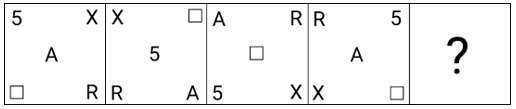
Which figure should replace the question mark (?) if the following series were to be continued?
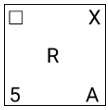
- (a)
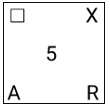
- (b)
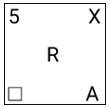
- (c)
- (d)
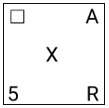
Answer
Why
Correct — B. Each box holds 5, X, A, R and a small empty square in the four corners and the centre.
Rule 1: X and R walk the corners, top-right → top-left → bottom-right → bottom-left, R two steps ahead of X.
Rule 2: the other three slide down one place in the column the pair leaves free, the bottom one wrapping to the top.
In figure 4, R is top-left and X bottom-left, so next they move to bottom-right and top-right, freeing the left column.
Figure 4's trio reads 5, A, square from the top. Slid down it becomes square, 5, A: square top-left, 5 centre, A bottom-left, X top-right, R bottom-right → option (b).
Why the others are wrong
- (a)Option (a) puts R in the centre. Across all four given figures R and X keep to the corners, and the centre is held by 5, A or the square.
- (c)Option (c) also parks R in the centre, and it leaves 5 and the square in the corner slots they held back in figure 1. The vertical trio has to slide one place at every step.
- (d)Option (d) sends X into the centre and pushes A out to a corner. A rides the vertical line and X belongs to the corner pair, so both are in the wrong group.
Concept
Read a figure series like this by writing each box out as five labelled slots — top-left, top-right, centre, bottom-left, bottom-right — before you look at the options. The pattern is a movement of items between fixed slots, and a table makes it visible in a way staring does not.
Then ask which items behave differently from the rest. Here two of them, X and R, never touch the centre while the other three take turns in it.
Splitting the five into those two groups is the step that unlocks the item, because each group then obeys a simple rule of its own.
X and R always take the two corners of one column, and it is always the column the trio is not using. That is a consequence of the two rules working together, not a third rule to memorise.
Key facts
- X occupies top-right, top-left, bottom-right and bottom-left across figures 1 to 4, in that order.
- R runs the same corner loop two steps ahead of X, holding bottom-right, bottom-left, top-right and top-left.
- The centre is held by A, then 5, then the square, then A again.
Study next
Common traps
- Trying to find a single movement that fits all five items at once.
- Treating the small square as an empty slot rather than as an item that travels.
- Choosing an option on its corner letters alone without checking the centre.
A line of three sliding one place per step also decides Reasoning Q.8 of the 24 Sep 2024, 09:00 paper. There the other two items hold still, and the moving line alternates between the row and the column instead of between the two side columns.
Related PYQs
No directly related past PYQ was found.