
Let 3t − 1⁄(3t) = 3, then which of the following expressions has the value equal to 12?

- (a)

- (b)
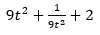
- (c)

- (d)

Answer
Why
Correct — C. The stem, printed as an image, sets 3t − 1⁄(3t) = 3 and asks which listed expression equals 12.
Write x = 3t, so the condition is x − 1⁄x = 3 and 9t² + 1⁄(9t²) is exactly x² + 1⁄x².
Square both sides:
(x − 1⁄x)² = x² − 2 + 1⁄x² = 9
x² + 1⁄x² = 9 + 2 = 11
So 9t² + 1⁄(9t²) = 11, and the expression worth 12 is that quantity plus 1 → option (c).
Why the others are wrong
- (a)Option (a) is 9t² + 1⁄(9t²) − 2, which evaluates to 11 − 2 = 9. Subtracting 2 undoes the correction that the squaring introduced rather than applying it.
- (b)Option (b) is 9t² + 1⁄(9t²) + 2, which evaluates to 11 + 2 = 13. The +2 has already been used to lift 9 to 11, so adding it a second time overshoots.
- (d)Option (d) is 9t² + 1⁄(9t²) with nothing attached, and that is 11 — the squared expression itself, one short of the 12 asked for.
Concept
This is the x − 1⁄x family, and it rests on one identity: (x − 1⁄x)² = x² + 1⁄x² − 2.
Rearranged, x² + 1⁄x² = (x − 1⁄x)² + 2. The companion form (x + 1⁄x)² = x² + 1⁄x² + 2 differs only in that sign, which is why the +2 and −2 options are both on the list.
The 3t is cosmetic. Substituting x = 3t turns 9t² + 1⁄(9t²) into x² + 1⁄x², and the coefficient never has to be handled separately.
The value 12 asked for is x² + 1 + 1⁄x², which is the middle factor of x³ − 1⁄x³ = (x − 1⁄x)(x² + 1 + 1⁄x²). That gives 3 × 12 = 36 as the cube difference here, so the same 12 is reusable if a later part asks for 27t³ − 1⁄(27t³).
Key facts
- (x − 1⁄x)² = x² + 1⁄x² − 2, so x² + 1⁄x² = (x − 1⁄x)² + 2.
- (x + 1⁄x)² = x² + 1⁄x² + 2, the same identity with the middle sign reversed.
- With 3t − 1⁄(3t) = 3, the quantity 9t² + 1⁄(9t²) equals 11.
Study next
Common traps
- Squaring 3t − 1⁄(3t) = 3 and writing 9t² + 1⁄(9t²) = 9, forgetting the −2 cross term.
- Squaring the 3t but leaving 1⁄(3t) unsquared, which produces 9t² + 1⁄(3t) and goes nowhere.
The condition is set on 3t rather than a bare x, so the substitution has to come first and the identity second. The same "which of the following expressions" framing on a linear condition is used at 9 Sep 2024, 16:00, Quant Q.8.
Related PYQs
No directly related past PYQ was found.