
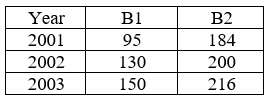
The sale of two kinds of bicycles B1 and B2 (in lakhs) manufactured by a company over a period of three years are shown in the table below. From 2001 to 2003, the total sale of bicycles B1 is what percent of the total sale of bicycles B2?
- (a)56.7%
- (b)68.2%
- (c)62.5%
- (d)70.6%
Answer
Why
Correct — C. "B1 is what percent of B2" puts the B2 total in the denominator, so both columns have to be totalled first.
Total B1, 2001 to 2003:
95 + 130 + 150 = 375 lakh
Total B2, 2001 to 2003:
184 + 200 + 216 = 600 lakh
375⁄600 × 100
= 0.625 × 100 = 62.5% → option (c)
375⁄600 reduces to 5⁄8, and 5⁄8 is 62.5% exactly, so no rounding is involved.
Why the others are wrong
- (a)56.7% — 56.7% of the 600 lakh B2 total is about 340 lakh, some 35 lakh short of what B1 actually sold. Add the B1 column again: 95 + 130 + 150 = 375.
- (b)68.2% — 68.2% of 600 lakh is about 409 lakh, well above B1's 375. This is the size of answer you get when the B2 column is totalled short, so re-add it: 184 + 200 + 216 = 600.
- (d)70.6% — 70.6% of 600 lakh is about 424 lakh. The question asks about the three-year totals, not the best single year, and even 2003 alone gives only 150⁄216 ≈ 69.4%.
Concept
"A is what percent of B" always means A⁄B × 100, and the word after "of" tells you the denominator. Here that word is B2.
The other decision is when to divide. For a multi-year question you total each column first and divide once, because a percentage of a sum is not the average of the yearly percentages.
The yearly ratios here run 51.6%, 65% and 69.4%, whose average is 62.0% — close to 62.5%, but not the same number and not what the stem asks for.
Read the two column headings before you touch the arithmetic. Swap them and 375⁄600 becomes 600⁄375 = 160%, which is not among the options — a sign you have the ratio the wrong way round.
Key facts
- B1 sold 95, 130 and 150 lakh bicycles in 2001, 2002 and 2003, a three-year total of 375 lakh.
- B2 sold 184, 200 and 216 lakh over the same three years, a total of 600 lakh.
- 375 out of 600 is 5⁄8, which is exactly 62.5%.
- B1 as a share of both makes together would be a different figure: 375⁄975 ≈ 38.5%.
Study next
Common traps
- Dividing by the combined sale of 975 lakh instead of by B2's 600, which gives 38.5%.
- Averaging the three yearly ratios (51.6%, 65%, 69.4%) to 62.0% instead of dividing the totals.
- Totalling only 2002 and 2003 because the stem says "from 2001 to 2003" and 2001 is read as a starting point rather than a data year.
Here the table is small and one percentage is asked, so the marks are in reading the heading, not in the arithmetic.
A four-row table asking for the percentage of non-vegetarian students appears at Quant Q.13 of this paper, and a bar graph asking for a percentage decrement at Quant Q.5.
Related PYQs
No directly related past PYQ was found.