
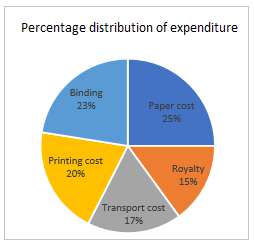
The given pie-chart shows the percentage distribution of the expenditure incurred in publishing a book. What is the central angle of the sector corresponding to the expenditure incurred on binding?
- (a)82.8°
- (b)48.8°
- (c)78.8°
- (d)61.8°
Answer
Why
Correct — A. Rule: a pie chart's full circle is 360°, so a sector's angle is its percentage × 360 ⁄ 100 — that is 3.6° for every percentage point.
The chart labels the binding slice 23%.
23 × 3.6 = 82.8° → option (a)
Sanity check on the chart: 25 + 23 + 20 + 17 + 15 = 100%, so no sector has been left out of the drawing.
Why the others are wrong
- (b)48.8° — 48.8° answers no label on the chart — 48.8 ⁄ 3.6 is about 13.6%, and nothing reads 13.6. The nearest slice is royalty at 15%, which would be 54°.
- (c)78.8° — 78.8° is near enough to 82.8 to slip past a hurried multiplication, but it corresponds to about 21.9%. Binding is labelled 23%, and 23 × 3.6 is 82.8.
- (d)61.8° — 61.8° is roughly the transport cost slice, labelled 17% and worth 61.2°. Landing here means reading the wrong sector of the pie, not applying the wrong formula.
Concept
A pie chart converts share into angle at a fixed exchange rate: 100% = 360°, so 1% = 3.6°.
That is the entire computation, and it needs nothing else. The rupee total of the expenditure, if the question gives one, is irrelevant to an angle — it only matters when the question asks for an amount.
The reverse conversion is just as common: divide a given angle by 3.6 to recover the percentage, then apply it to the total.
The five labelled slices are paper cost 25%, binding 23%, printing cost 20%, transport cost 17% and royalty 15%. Binding is the second-largest sector, drawn at the upper left.
Key facts
- A full pie chart is 360°, so one percentage point is 3.6°.
- Binding is labelled 23%, giving 23 × 3.6 = 82.8°.
- The five sectors sum to 100%: paper 25, binding 23, printing 20, transport 17, royalty 15.
- A central angle needs only the percentage, never the absolute total.
Study next
Common traps
- Reading a neighbouring slice's label when the pie is drawn small
- Multiplying by 100 rather than 360 and reporting the percentage as the angle
- Dragging the total expenditure into a question that asks only for an angle
The angle version of a pie chart is SSC's one-step variant.
Also asked 24 Sep 2024, 16:00, Quant Q.9, where the angle for the drawing sector is wanted even though a total expenditure is supplied, and 13 Sep 2024, 09:00, Quant Q.20, which asks for the combined angle of two slices.
Related PYQs
No directly related past PYQ was found.