
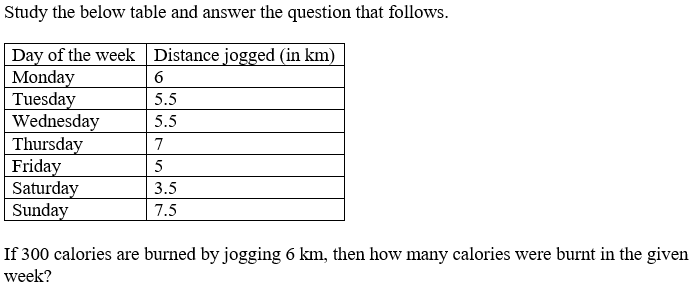
Study the below table and answer the question that follows. Day of the week → Distance jogged (in km) Monday — 6 Tuesday — 5.5 Wednesday — 5.5 Thursday — 7 Friday — 5 Saturday — 3.5 Sunday — 7.5 If 300 calories are burned by jogging 6 km, then how many calories were burnt in the given week?
- (a)1600
- (b)2000
- (c)2200
- (d)1800
Answer
Why
Correct — B. The table gives seven distances. Add them first, then apply the calorie rate once.
Mon + Tue + Wed = 6 + 5.5 + 5.5 = 17 km
Add Thu 7 → 24 km
Add Fri 5 → 29 km
Add Sat 3.5 → 32.5 km
Add Sun 7.5 → 40 km for the week
Rate: 300 calories per 6 km, so 300 ⁄ 6 = 50 calories per km.
40 × 50 = 2,000 calories → option (b)
Why the others are wrong
- (a)1600 — 1600 is what 32 km would burn at 50 calories per km. The seven rows add to 40 km, eight kilometres more, so this is an under-count of the column rather than a wrong rate.
- (c)2200 — 2200 needs 44 km. The column gives 40 km, so this over-counts by exactly 4 — which is what happens if Saturday's 3.5 is read as a second 7.5.
- (d)1800 — 1800 is either 36 km at the correct rate, or 300 × 6 if you multiply the rate by Monday's distance instead of by the week's 40 km. Both routes skip the total.
Concept
This is the unitary method sitting on top of a data table, and the two halves are independent.
First the table: seven values, no weighting, plain addition to 40 km. Nothing in the question asks you to treat weekdays and weekend differently.
Then the rate: 300 calories buy 6 km, so one kilometre costs 50 calories. Find the unit rate once and apply it to the total — never day by day, which multiplies your chances of an arithmetic slip by seven.
The stem is short but the data lives in an image. If the table does not render, the numbers are Monday 6, Tuesday 5.5, Wednesday 5.5, Thursday 7, Friday 5, Saturday 3.5, Sunday 7.5 kilometres.
Key facts
- The seven distances in the table add to 40 km.
- 300 calories per 6 km is a unit rate of 50 calories per kilometre.
- 40 km at 50 calories per km is 2,000 calories.
- The half-kilometre entries (5.5, 5.5, 3.5, 7.5) sum to 22, which is a quick way to check the addition.
Study next
Common traps
- Adding only the five weekdays and leaving Saturday and Sunday out
- Multiplying 300 by the number of days instead of by the distance
- Applying 300 calories to each day's run regardless of how long it was
SSC prints a small table as an image and asks a single arithmetic question off it — a total, a ratio, an average or a percentage.
The same table-reading is asked 13 Sep 2024, 09:00, Quant Q.1 (percentage of marks from a table) and 9 Sep 2024, 16:00, Quant Q.11 (which company had the highest four-year average).
Related PYQs
No directly related past PYQ was found.