
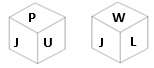
Six letters P, J, U, W, L and K are written on different faces of a dice. Two positions of this dice are shown in the figures below. Find the letter on the face opposite to P.
- (a)K
- (b)W
- (c)U
- (d)J
Answer
Why
Correct — B. Two views are drawn. In the first, P is on top with J on the left face and U on the right.
In the second, W is on top with J again on the left face and L on the right.
Rule: two faces drawn in the same picture share an edge, so neither can be opposite the other.
J holds the left face in both views, so the die was turned about the axis running through J and the face behind it. J is drawn beside P, U, W and L, which leaves K as the face opposite J.
That makes P, U, W and L a ring of four round the J–K axis. A quarter-turn about that axis would bring P to the right face or U to the top, and the second view shows L and W there instead.
So the turn is a half-turn, which swaps top with bottom. W arrives on top, so W was the bottom face while P was on top: P is opposite W → option (b).
Why the others are wrong
- (a)K — K is the one letter that never appears. It is opposite J, the face that keeps its place across both views, not opposite P.
- (c)U — U is drawn on the right face while P is on top in the first view. Faces shown together share an edge and cannot be opposite.
- (d)J — J stands beside P in the first view, so it touches P. J is the face the die turns about, and its opposite is K.
Concept
A die has three opposite pairs. Every face you can see in one drawing touches the other two you can see, so each picture rules out three pairings at once.
When a letter appears in both views, it is doing double duty: it tells you which faces touch it, and it tells you the axis the die was turned about. Both facts are needed here, because adjacency alone only settles K.
Adjacency alone gives you K opposite J and no more. The other two pairs need the rotation argument — which is why quarter-turns have to be ruled out explicitly rather than assumed away.
Key facts
- Faces visible in the same drawing are adjacent, never opposite.
- J occupies the left face in both views, so P, U, W and L all touch it and K is opposite J.
- A half-turn about the J–K axis swaps the top face with the bottom face.
- The six letters here are P, J, U, W, L and K.
Study next
Common traps
- Naming the unseen letter out of habit — here K is opposite J, not P.
- Assuming the two views differ by a quarter-turn without testing it.
- Treating the left and right faces as a fixed pair when only the left one repeats.
Two-view letter dice run at 09 Sep 2024, 16:00, Reasoning Q.3 (P, Q, R, S, T, U — find the face opposite R) and 10 Sep 2024, 09:00, Reasoning Q.12 (S, T, M, P, R, C — find the face opposite M).
Related PYQs
No directly related past PYQ was found.