
Identify the figure from among the given options which when put in place of the question mark (?) will logically complete the series.
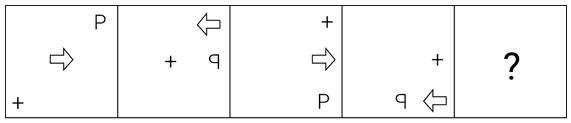
- (a)
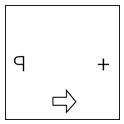
- (b)
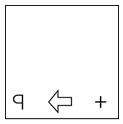
- (c)
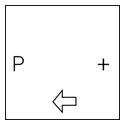
- (d)
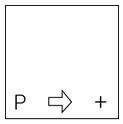
Answer
Why
Correct — D. Two rules run at once, and you need both.
Rule 1: each of the three symbols advances one place along the same fixed track, staying one place apart.
The track runs bottom-left, then centre, then top-right, then middle-right, then bottom-right, then bottom-centre.
The plus walks bottom-left, centre, top-right, middle-right — so in box 5 it reaches bottom-right.
The arrow walks centre, top-right, middle-right, bottom-right — so it reaches bottom-centre.
The letter walks top-right, middle-right, bottom-right, bottom-centre — so it reaches bottom-left.
All three land on the bottom row, which leaves only options (b) and (d) standing.
Rule 2: the letter alternates P, q, P, q and the arrow alternates right, left, right, left. Box 5 is an odd box like boxes 1 and 3, so it takes their forms — P and a right-pointing arrow. That is option (d).
Why the others are wrong
- (a)Its arrow is correctly at bottom-centre, but the plus sits at middle-right and the letter at middle-left — each one row above where the track puts them at step 5. Its letter is also q, an even-box form.
- (b)The positions are right — letter bottom-left, arrow bottom-centre, plus bottom-right — but it prints q with a left-pointing arrow, which is the box-2 and box-4 pairing. Box 5 is odd and must repeat box 1.
- (c)Its plus and letter sit one row too high, the same positional error as option (a). It also pairs P with a left-pointing arrow, a combination none of the four given boxes shows.
Concept
This figure series runs two independent rules at once: one governing where the elements sit, another governing how they look. Solving only the first leaves a tie between two options.
The position rule here is a closed track that all three symbols walk at the same speed, so their spacing never changes. That fixes the row and column of every symbol in the missing box.
The form rule is a plain alternation. Because the plus looks the same either way, the alternation is visible only on the letter and the arrow — and those two are what separate the surviving options.
Options (b) and (d) are identical in layout and differ only in the letter and the arrow direction, so a candidate who reads position alone is left guessing between two. Give the form rule its own pass.
Key facts
- The track is a six-position loop: bottom-left, centre, top-right, middle-right, bottom-right, bottom-centre.
- The arrow is always one place ahead of the plus on that track, and the letter one place ahead of the arrow.
- The letter and the arrow alternate by parity, so boxes 1 and 3 show P with a right-pointing arrow while boxes 2 and 4 show q with a left-pointing arrow.
- In the missing box all three symbols sit on the bottom row.
Study next
Common traps
- Choosing on position alone, which leaves options (b) and (d) tied
- Carrying box 4's forms straight into box 5 instead of alternating them
- Tracking one symbol and assuming the other two move differently
Another figure-series completion is set at Reasoning Q.13, 19 Sep 2024, 16:00. Both reward the same discipline: settle the positions first to cut the option list, then look for the second rule that separates whatever survives.
Related PYQs
No directly related past PYQ was found.