
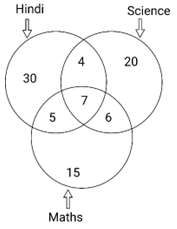
Study the given diagram carefully and answer the question that follows. The numbers in different sections indicate the number of students who like particular subjects. How many students like Hindi and Science both, but NOT Maths?
- (a)4
- (b)11
- (c)12
- (d)10
Answer
Why
Correct — A. Rule: both means the overlap; but NOT means the slice of that overlap lying outside the third circle.
The diagram sets Hindi at the upper left, Science at the upper right and Maths below, with 30, 20 and 15 in the three single-subject regions.
The Hindi–Science overlap is split in two by the Maths circle. The part inside Maths holds 7; the part outside it holds 4.
The question wants Hindi and Science while excluding Maths, so it wants that outer slice alone: 4, which is option (a). The 7 sits directly beneath it to invite the other reading.
Why the others are wrong
- (b)11 — 11 is 4 + 7, the whole Hindi–Science overlap including the students who also like Maths. Those are the students the phrase but NOT Maths removes.
- (c)12 — 12 is 5 + 7, the full Hindi–Maths overlap. It answers a different question, pairing Hindi with the wrong second subject.
- (d)10 — 10 matches no single region of the diagram. It is 4 + 6, which adds the Science–Maths slice to the one actually asked for.
Concept
A three-circle Venn item hands you the counts already broken into regions, so there are no equations to solve. The work is translation — turning a sentence into the region or regions it names.
Three circles make seven regions: three single-subject areas, three pairwise slices lying outside the third circle, and the centre where all three meet.
Both X and Y covers two of those regions, the pairwise slice and the centre. Adding but NOT Z deletes the centre and leaves the slice by itself.
The 7 in the centre is placed to catch exactly the reading the question rules out, which is why it is worth naming the region before reading any number off the diagram.
Key facts
- The single-subject regions hold 30 for Hindi, 20 for Science and 15 for Maths.
- The Hindi–Science overlap holds 4 outside Maths and 7 inside it.
- The Hindi–Maths slice outside Science holds 5, and the Science–Maths slice outside Hindi holds 6.
- Students liking all three subjects number 7, the centre region.
Study next
Common traps
- Adding the central 7 because those students do like Hindi and Science
- Taking a pairwise overlap as the whole lens rather than the part outside the third circle
- Answering for the wrong pair of subjects, which gives 12 for Hindi and Maths
The counts arrive already split by region, so the arithmetic never exceeds one addition. The marks turn entirely on naming the right region, which is why rewriting the sentence as a region before looking at the figure is worth the ten seconds.
Related PYQs
No directly related past PYQ was found.