
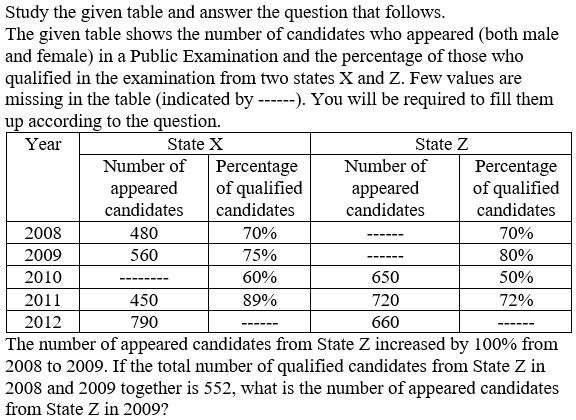
Study the given table and answer the question that follows. The given table shows the number of candidates who appeared (both male and female) in a Public Examination and the percentage of those who qualified in the examination from two states X and Z. Few values are missing in the table (indicated by ------). You will be required to fill them up according to the question. Year → State X Number of appeared candidates | State X Percentage of qualified candidates | State Z Number of appeared candidates | State Z Percentage of qualified candidates 2008 — 480 | 70% | ------ | 70% 2009 — 560 | 75% | ------ | 80% 2010 — -------- | 60% | 650 | 50% 2011 — 450 | 89% | 720 | 72% 2012 — 790 | ------ | 660 | ------ The number of appeared candidates from State Z increased by 100% from 2008 to 2009. If the total number of qualified candidates from State Z in 2008 and 2009 together is 552, what is the number of appeared candidates from State Z in 2009?
- (a)600
- (b)240
- (c)480
- (d)360
Answer
Why
Correct — C. Work in one unknown. Let State Z's appeared count for 2008 be x.
A 100% increase doubles it, so appeared in 2009 = 2x
Qualified 2008 = 70% of x = 0.7x
Qualified 2009 = 80% of 2x = 1.6x
0.7x + 1.6x = 2.3x = 552
x = 552 ⁄ 2.3 = 240, the 2008 figure
Appeared in 2009 = 2x = 480 → option (c)
Check: 168 qualified in 2008 plus 384 in 2009 = 552.
Why the others are wrong
- (a)600 — 600 in 2009 would mean 300 in 2008, and 70% of 300 plus 80% of 600 is 210 + 480 = 690 qualified, not 552.
- (b)240 — 240 is the 2008 figure — it is x, and the question asks for 2x. Back-substituting gives 84 + 192 = 276 qualified, well short of 552.
- (d)360 — 360 in 2009 would mean 180 in 2008, giving 126 + 288 = 414 qualified, still short of 552.
Concept
A missing-value table is an equation in disguise. The table supplies the rates — State Z qualified 70% in 2008 and 80% in 2009 — and the stem supplies the relations, here a 100% rise in appeared candidates and a combined qualified total of 552.
Set the earliest unknown as x and push forward from it. A 100% increase means the new value is 2x, not x + 100 and not 100% of x.
Weighted totals like 0.7x + 1.6x = 2.3x are the whole technique: one unknown, one equation, then read off whichever multiple of x the question actually asked for.
Only State Z's 2008 and 2009 rows are needed. The State X columns and Z's 2010 to 2012 rows are there to be left alone, and reading them costs time.
Key facts
- An increase of 100% doubles a quantity.
- State Z's qualifying rates are 70% for 2008 and 80% for 2009, both read straight from the table.
- 0.7x + 1.6x = 552 gives x = 240 appeared in 2008 and 480 appeared in 2009.
- The check is 168 qualified in 2008 plus 384 in 2009, totalling 552.
Study next
Common traps
- Answering 240, the 2008 figure, when the question asks about 2009.
- Reading a 100% increase as an increase of 100 candidates.
- Applying the 2008 rate of 70% to the 2009 count.
The table carries deliberately blank cells and the stem tells you how to fill exactly the ones you need — filling the rest is wasted time.
Table-based averaging is asked at Quant Q.5 of this shift, and the same subset reasoning off a pie chart at Quant Q.10.
Related PYQs
No directly related past PYQ was found.