
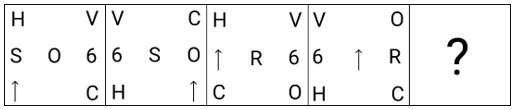
Which figure should replace the question mark (?) if the following series were to be continued?
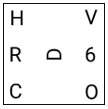
- (a)
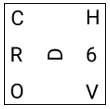
- (b)
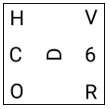
- (c)
- (d)
Answer
Why
Correct — C.
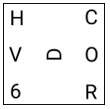
Rule: read alternate figures — 1, 3 and 5 share one arrangement, 2 and 4 another.
In figures 1 and 3 three symbols never move: H top-left, V top-right, 6 middle-right.
The other four ride a fixed track — centre → bottom-right → bottom-left → middle-left → out of the grid — and one new symbol enters at the centre each time.
Figure 1: O at centre, C bottom-right, the arrow bottom-left, S middle-left.
Figure 3: R at centre, O bottom-right, C bottom-left, the arrow middle-left, and S has gone.
Figure 5 must then hold the new half-disc at the centre, R bottom-right, O bottom-left, C middle-left and no arrow — which is option (c).
Why the others are wrong
- (a)Option (a) leaves C at bottom-left and O at bottom-right, exactly where figure 3 has them. Every travelling symbol has to advance one station, so C must reach middle-left and O bottom-left.
- (b)Option (b) breaks the anchors: H sits top-right and C top-left. H holds the top-left corner in figures 1 and 3 and does not move at all.
- (d)Option (d) moves the anchors too — 6 drops to bottom-left and V takes middle-left, though 6 holds middle-right and V the top-right throughout the odd figures.
Concept
Figure series built from letters and digits are position puzzles, not shape puzzles. Write out the grid of each figure and compare it cell by cell.
Two structures do most of the work. Some symbols are anchors that never move, and the rest travel a fixed track, one station per step, with a symbol leaving at the end of it and a new one joining at the start.
When consecutive figures refuse to line up, try alternate figures. Figure 1 maps onto figure 3 cleanly here, and figure 2 onto figure 4 by its own anchors, so the series runs as two interleaved threads.
Every option carries the same half-disc in the centre cell, so the centre settles nothing. The four differ only in where H, V, 6, C, O and R are placed.
Key facts
- Figures 1 and 3 both keep H top-left, V top-right and 6 middle-right.
- The travelling symbols move centre to bottom-right to bottom-left to middle-left, then leave the grid.
- On the odd-numbered thread the centre takes a symbol new to the series: R in figure 3, the half-disc in figure 5.
- Figures 2 and 4 run a track of their own, anchored on V top-left, 6 middle-left and H bottom-left.
Study next
Common traps
- Trying to map figure 1 onto figure 2 and abandoning the item when no single movement fits.
- Choosing option (a) because the three anchors are right, without checking that the travelling symbols have advanced.
Figure series completion is also set at Reasoning Q.20 in this shift. When a symbol grid resists a step-by-step rule, compare figures two apart before giving up on it.
Related PYQs
No directly related past PYQ was found.