
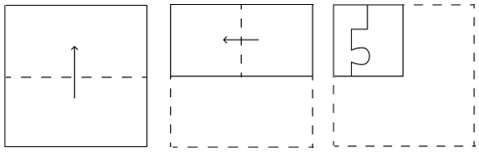
A paper is folded and cut as shown below. How will it appear when unfolded?
- (a)
- (b)
- (c)
- (d)
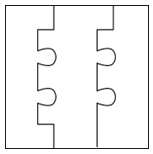
Answer
Why
Correct — A.
Rule: unfold in reverse order, mirroring the cut across each crease in turn.
The sheet is folded bottom-half upward, then right-half leftward, leaving the top-left quarter. That quarter carries the cut.
Undo the second fold first: the cut reappears mirrored about the vertical crease, so the finished sheet must hold a matched left-and-right pair.
Undo the first fold next: everything reappears mirrored about the horizontal crease, so each cut must also read the same above and below the middle.
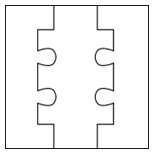
Option (a) is the one figure that passes both tests — its two cuts are mirror images of each other, and each is unchanged when folded at mid-height.
Why the others are wrong
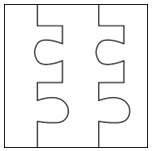
- (b)The two cuts in option (b) are translations of one another, not mirror images, and its upper and lower lobes bulge opposite ways. Neither crease could have produced it.
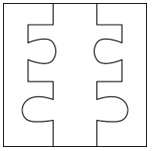
- (c)Option (c) fails the horizontal test. Fold it at mid-height and the cut above the middle does not cover the cut below it, though a fold there forces them to match.
- (d)Both cuts in option (d) bulge the same way, so the right-hand one is a copy shifted across rather than a reflection. Unfolding a vertical crease has to reverse the second copy.
Concept
Paper folding runs in one direction only. Every fold halves the sheet, and every unfold mirrors what is there across the crease you are undoing — in the reverse of the order the folds were made.
Two folds therefore leave four copies of the cut and a figure with two axes of symmetry, one along each crease. That is a check you can run on the options before tracing anything.
The quarter's own edges matter as well. A cut running to a crease continues into the neighbouring panel when you unfold, while a cut stopping at a genuine paper edge does not.
The stem prints the fold sequence as three panels: the dashed line is the crease, the arrow shows which half travels, and the last panel shows the cut made in the folded packet. Nothing is cut until that last panel.
Key facts
- Two folds produce four copies of the cut, one in each quarter of the sheet.
- The last fold made is the first fold undone.
- The cut here reaches the quarter's lower edge, which is the horizontal crease, so it runs unbroken across the finished sheet.
Study next
Common traps
- Unfolding in the order the folds were made rather than in reverse.
- Accepting an option because it carries two cuts, without checking that the second is a mirror of the first.
Paper folding and cutting is also set at Reasoning Q.23 in this shift. Testing the options for symmetry about each crease usually settles these faster than tracing the cut through the folds.
Related PYQs
No directly related past PYQ was found.