
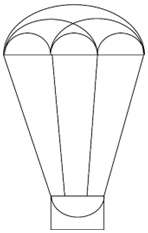
How many semicircles are there in the given figure?
- (a)6
- (b)5
- (c)7
- (d)8
Answer
Why
Correct — C. Rule: count every arc whose two ends sit on the same straight line — that line is its diameter.
Three small arcs stand on the canopy's horizontal line, one on each third of it.
Two larger arcs each span two of those thirds and cross near the top centre.
One outermost arc spans the whole line from end to end.
One more arc hangs inside the basket, its ends at the top corners of the rectangle.
3 + 2 + 1 + 1 = 7, which is option (c).
Why the others are wrong
- (a)6 — 6 is the canopy alone — three small arcs, two spanning two-thirds and one across the whole width. It misses the arc inside the basket at the foot of the figure.
- (b)5 — 5 is what you get by counting the three small arcs, the outermost arc and the basket arc, and overlooking the two larger arcs that cross near the top centre.
- (d)8 — 8 needs an eighth arc, and the figure has none: every curve that ends on a straight line is already counted — three small, two spanning two-thirds, one full-width and the basket's.
Concept
A semicircle needs two things: a curve that is half a circle, and a straight line joining its ends to serve as the diameter. Counting items are won by hunting for that straight line first.
One horizontal line runs across the base of the canopy here, and it is divided into three equal parts. Every canopy arc has both ends on that line — on one third, on two thirds, or on the whole of it.
The basket is a separate frame: the rectangle's top edge is a straight line, and the curve dipping below it uses that edge as its diameter.
The two arcs spanning two-thirds cross each other, which is what makes them easy to lose — the eye reads the crossing as a single decorative curve.
Key facts
- An arc counts as a semicircle only when the straight line joining its ends is present in the figure.
- The canopy's base line is split into three equal parts, which is what allows arcs of three different spans.
- The figure holds seven semicircles: three small, two spanning two-thirds each, one full-width and one inside the basket.
Study next
Common traps
- Counting the canopy and forgetting the arc inside the basket.
- Missing the two larger arcs because they cross and read as one shape.
- Splitting each crossing arc into the halves either side of the crossing point and counting four where there are two.
The stem names one shape and the picture layers it at several sizes, so the count is settled by walking each straight line and asking what rests on it, not by scanning the picture as a whole.
Related PYQs
No directly related past PYQ was found.