
Identify the figure given in the options which when put in place of the question mark (?) will logically complete the series?
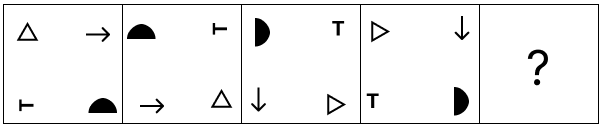
- (a)
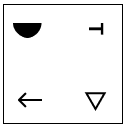
- (b)
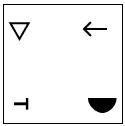
- (c)
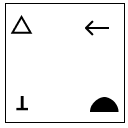
- (d)
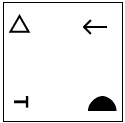
Answer
Why
Correct — B. Rule: the frames alternate between a diagonal jump and a quarter-turn clockwise.
Frames 1 to 2 and 3 to 4 are jumps: each of the four figures moves to the diagonally opposite corner and its facing is untouched.
Frame 2 to 3 is a turn: nothing moves, and every figure rotates 90 degrees clockwise where it stands.
So frame 5 is that turn applied to frame 4, corner by corner.
triangle pointing right → points down (top-left)
arrow pointing down → points left (top-right)
bar-and-stem sitting as a T → stem swings round to point left (bottom-left)
half-disc bulging right → bulges downward (bottom-right)
All four land in option (b).
Why the others are wrong
- (a)It carries the same four correctly turned figures, but at the diagonally opposite corners — it turns and jumps in one step. Frame 5 only turns; the jump was frame 3 to frame 4.
- (c)Two of its figures are never turned: the triangle still points up and the half-disc still bulges upward, as in frame 1. Its bar-and-stem has swung a half-turn from frame 4's T, not a quarter-turn.
- (d)Its arrow and bar-and-stem are turned correctly, but the triangle points up and the half-disc bulges up — two corners left at their frame-1 facing.
Concept
A figure series hides two independent variables: where each element sits, and which way it faces. Track them separately or you will mark an option that gets one right.
Fix the cast first — an outline triangle, an arrow, a bar-and-stem and a filled half-disc run through every frame — then ask, frame by frame, whether the corners changed or the facings changed.
Here the two never change in the same step, and that is what makes the last frame decidable: frames 3 and 4 differ only in position, so frame 5 must differ from frame 4 only in facing.
Options (a) and (b) carry the identical four figures at the identical facings and differ only in which corner each one occupies, so the shape check alone cannot separate them.
Key facts
- Position and orientation are separate variables in a figure series, and in this one they change in alternate steps.
- A quarter-turn clockwise sends an up-triangle to a right-triangle, a right arrow to a down arrow, and a half-disc bulging up to one bulging right.
- A diagonal jump swaps top-left with bottom-right and top-right with bottom-left, leaving every facing alone.
Study next
Common traps
- Checking the four shapes, finding them all correct, and marking that option without checking the corners.
- Reading the alternation backwards and applying a jump to frame 4 instead of a turn.
- Turning anticlockwise, which simply returns the figures to their frame-1 facings — what options (c) and (d) show at two corners.
The options are pictures, so the elimination is visual: the facings knock out two options and only the corner arrangement separates the rest. Reasoning Q.3 of this shift runs another figure series, and Q.25 asks you to read symbols after a flip rather than a turn.
Related PYQs
No directly related past PYQ was found.