
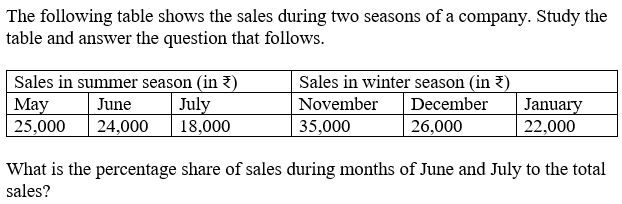
The following table shows the sales during two seasons of a company. Study the table and answer the question that follows. Sales in summer season (in ₹) → May | June | July 25,000 | 24,000 | 18,000 Sales in winter season (in ₹) → November | December | January 35,000 | 26,000 | 22,000 What is the percentage share of sales during months of June and July to the total sales?
- (a)30%
- (b)24%
- (c)28%
- (d)33%
Answer
Why
Correct — C. Read the two months asked for, then the whole table.
June + July = 24,000 + 18,000 = ₹42,000
Total = 25,000 + 24,000 + 18,000 + 35,000 + 26,000 + 22,000
= ₹67,000 (summer) + ₹83,000 (winter) = ₹1,50,000
Share = 42,000 ⁄ 1,50,000 × 100
= 0.28 × 100 = 28% → option (c)
Why the others are wrong
- (a)30% — 30% of ₹1,50,000 is ₹45,000, three thousand more than June and July actually bring in. It is the rounded neighbour of the true figure, not the figure.
- (b)24% — 24% would need ₹36,000. The number merely echoes June's ₹24,000 sales, which is one month of the pair rather than a percentage.
- (d)33% — 33% is one-third of the table, or ₹50,000. Two months out of six average a third only if every month sold the same amount, and here they do not.
Concept
A share question is one fraction: the part over the whole, times 100.
The part is named in the question (June and July, ₹42,000) and the whole is the entire table, both seasons together, ₹1,50,000. Missing the winter half is the standard way this is lost.
Adding the six figures in season blocks — ₹67,000 and ₹83,000 — is quicker and easier to check than one running total of six numbers.
The table gives only three months per season, so 'total sales' means the six months printed, not a full year. Answer with the data on the page.
Key facts
- The six months listed total ₹1,50,000 in sales.
- June and July together account for ₹42,000, which is 28% of that total.
- Winter sales of ₹83,000 exceed summer sales of ₹67,000 in this table.
Study next
Common traps
- Taking the total as the summer season alone, which turns 28% into roughly 63%.
- Adding May instead of July when the months are read too quickly.
- Rounding 42,000 to 45,000 to force a neat 30%.
SSC prints a small table and then asks a percentage that needs the grand total, so the arithmetic is trivial and the reading is not. Table-reading also carries Quant Q.12 and Q.23 in this shift.
Related PYQs
No directly related past PYQ was found.