
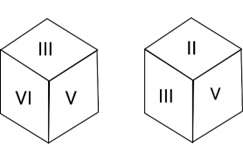
Six Roman numbers I, II, III, IV, V and VI are written on different faces of a dice. Two positions of this dice are shown in the figure below. Find the Roman number on the face opposite to ‘VI’.
- (a)III
- (b)IV
- (c)II
- (d)V
Answer
Why
Correct — C. V is on the right in both drawings, so the die has been turned about the V face.
Rule: a face is never opposite a face it is shown touching.
View 1 shows III on top, VI on the left, V on the right. View 2 shows II on top, III on the left, V on the right.
So V touches III, VI and II, and III touches VI, V and II.
Neither V nor III can partner any of those, so their partners must be I and IV, the two numerals never drawn — and that uses both up. VI and II are left to pair with each other: option (c).
Why the others are wrong
- (a)III — III is drawn beside VI in the first view, on the top and left of the same cube. Faces visible together share an edge and are never opposite.
- (b)IV — IV appears in neither drawing, which makes it look like the hidden partner. But I and IV are forced to pair with V and III, so IV is already committed.
- (d)V — V shares an edge with VI in the first view. It is also the face the die was rotated about, so it stays adjacent to VI in both drawings.
Concept
Two isometric views of one die give adjacency for free: the three faces in a single drawing all touch one another. Opposition then comes only by elimination.
A cube face touches four others and is opposite exactly one. Once a face has been seen touching three different faces, its partner has to come from what is left.
Here both V and III collect three neighbours, and only I and IV are never drawn at all. Those two get consumed as partners, and the two remaining faces pair off with each other.
Roman numerals change nothing about the method. They are there to slow you down while you read VI against V and III against II.
Key facts
- Each face of a cube touches four others and is opposite exactly one.
- When a face keeps the same position across both views, the die was rotated about that face.
- Here V is shown touching III, VI and II, so none of those can be opposite V.
Study next
Common traps
- Choosing the numeral that never appears, on the assumption it must be hidden opposite
- Treating the two drawings as two different dice instead of one die turned
- Misreading VI as IV when scanning quickly
SSC draws two isometric positions and asks for one opposite face, changing the labels between numbers, letters, symbols and Roman numerals.
A symbols version is at 13 Sep 2024, 12:30, Reasoning Q.25, and a letters version at 9 Sep 2024, 09:00, Reasoning Q.3.
Related PYQs
No directly related past PYQ was found.