
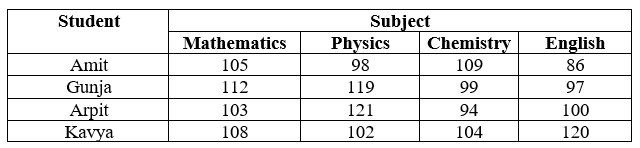
The table given below shows the marks obtained by four students in 4 different subjects. Maximum marks for each subject is 175. What is the aggregate percentage of marks obtained by Gunja in all the four subjects?
- (a)58
- (b)61
- (c)67
- (d)71
Answer
Why
Correct — B. Read Gunja's row only, then set her total against the total possible.
Marks: 112 + 119 + 99 + 97
112 + 119 = 231
231 + 99 = 330
330 + 97 = 427
Maximum = 4 subjects × 175 = 700
427 ⁄ 700 × 100 = 61% → option (b)
Why the others are wrong
- (a)58 — 58 needs a total of 406 marks. Gunja's four entries add to 427, and no row in the table totals 406 either — this is a near-miss decoy, not another student's aggregate.
- (c)67 — 67 would require 469 out of 700. It survives only on an inflated addition of Gunja's row, so recheck 112 + 119 + 99 + 97, which lands on 427.
- (d)71 — 71 is what 427 out of 600 comes to, rounded — the figure you reach by taking the maximum as 150 a subject. The stem states 175, so the total possible is 700 and the aggregate is exactly 61%.
Concept
An aggregate percentage is total scored ⁄ total maximum × 100, and the denominator has to count every subject in the row.
The table's own numbers set the trap: marks in the 90s and 100s look like percentages, but each subject is out of 175. Gunja's 112 in Mathematics is 64%, not 112%.
Aggregate percentage is not generally the average of the four subject percentages. It equals that average here only because all four subjects share the same maximum.
Only Gunja's row matters — the rest of the table is there to slow the read. Losing track of which row you are on is a likelier error than mis-adding four two-digit and three-digit numbers.
Key facts
- Gunja scored 112, 119, 99 and 97, which total 427.
- The maximum is 175 per subject, so four subjects give 700.
- 427 out of 700 is exactly 61%.
Study next
Common traps
- Treating the marks as percentages because they sit near 100.
- Using 100 or 150 as the per-subject maximum instead of 175.
- Adding down a subject column instead of across the Gunja row.
SSC pairs a small table with a one-step arithmetic ask, so the reading is the difficulty and not the sum — this same 19 Sep 2024, 09:00 paper asks for a plain average of six subject marks at Quant Q.12.
Related PYQs
No directly related past PYQ was found.