
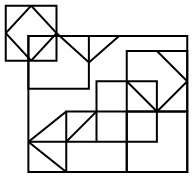
How many triangles are there in the given figure?
- (a)12
- (b)17
- (c)15
- (d)18
Answer
Why
Correct — D.
Rule: a triangle can only appear where a slanting line cuts a cell. The plain rectangles contribute none, so visit only the six places a slant is drawn.
Top-left square: the inscribed diamond cuts off the four corner triangles.
Top band: two long slants meet in a V on the vertical beneath them, giving the two halves and the whole — 3.
Right edge: the arrowhead's upper and lower slants each close against the right-hand edge — 2.
The two single-diagonal cells in the middle: one diagonal halves each — 2 + 2.
Bottom left: the lower slant halves a closed rectangle (2); the upper slant closes only downwards, because no horizontal runs this far left above it (1); and the two slants together bound one larger triangle (1) — 4.
That is seventeen you can be sure of.
The inscribed diamond is drawn a hair clear of the lines that cross it — at its lower-left side and again at its right vertex — and each near-miss clips off one more sliver of a triangle. The key marks 18 → option (d).
Why the others are wrong
- (a)12 — 12 is short by six. The bottom-left corner alone accounts for four triangles and the top band for three, which is seven before the top-left square is looked at.
- (b)17 — 17 is the sweep with every clipped corner treated as coincident and ignored — four in the top-left square and thirteen elsewhere. The key counts at least one of those clips, so 17 lands one short of what is marked.
- (c)15 — 15 is short by three. Each of the two middle cells gives two triangles rather than one, and the bottom-left corner gives four, because its two slants together bound a large triangle on top of the smaller ones.
Concept
Counting figures reward a fixed route rather than a stare. Two rules cut the work down.
First, a triangle needs a slanting side. Every triangle here has one, so the grid of plain rectangles can be ignored and only the slants need visiting.
Second, count in layers: the smallest triangles each slant makes, then any built by joining two of them. Two places in this figure produce such a composite.
Those are the V where two long slants meet on a vertical, and the bottom-left corner, where two slants leave the same point on the left edge and a vertical closes them off at their far ends.
The figure comes from a candidate's response sheet, about two hundred pixels across, and the inscribed diamond does not quite meet the lines that cross it. Its lower-left side is cut by the big rectangle's left edge just above the base, and its right vertex sits a shade above the big rectangle's top edge.
Each near-miss clips off a sliver that is technically a triangle. Ignore them all and the sweep gives seventeen; honour them all and it runs past eighteen. The key marks 18, so make one careful pass and move on rather than staring twice.
Key facts
- Every triangle in this figure has at least one slanting side, so the rectangles alone contribute none.
- The inscribed diamond cuts four corner triangles from the top-left square.
- Two long slants meeting on a vertical give three triangles: two halves and the whole.
- The bottom-left corner gives four triangles — two from the lower slant, one from the upper, and one from the pair together.
Study next
Common traps
- Counting only the smallest triangles and missing the ones made from two
- Counting a shape twice when a line passes through more than one cell
- Spending more than a minute on a counting item whose options sit one apart
'How many triangles are there in the given figure?' is printed word for word elsewhere: 9 Sep 2024, 12:30, Reasoning Q.1, keyed at 4, and 11 Sep 2024, 09:00, Reasoning Q.3, keyed at 11.
Related PYQs
No directly related past PYQ was found.