
What is the value of √((9sin²26° + 9sin²64° + 36) ⁄ (32 − 7cos²32° − 7cos²58°))?

- (a)
- (b)
- (c)
- (d)
Answer
Why
Correct — C. The stem is an image and the four options are images too. It asks for √[(9sin²26° + 9sin²64° + 36) ⁄ (32 − 7cos²32° − 7cos²58°)].
Both angle pairs are complementary, so each pair collapses to 1.
26° + 64° = 90°, so sin 64° = cos 26°
sin²26° + sin²64° = sin²26° + cos²26° = 1
Numerator = 9 × 1 + 36 = 45
32° + 58° = 90°, so cos 58° = sin 32°
cos²32° + cos²58° = cos²32° + sin²32° = 1
Denominator = 32 − 7 × 1 = 25
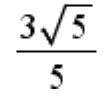
√(45 ⁄ 25) = √45 ⁄ 5 = 3√5 ⁄ 5 → option (c), the one printed as 3√5 over 5.
Why the others are wrong
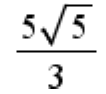
- (a)Option (a) shows 5√5 ⁄ 3. Squaring it gives 125 ⁄ 9, close to 13.9, while the fraction under the root is 45 ⁄ 25 = 1.8.
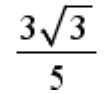
- (b)Option (b) shows 3√3 ⁄ 5, whose square is 27 ⁄ 25. The denominator is right but the numerator is not: 9 × 1 + 36 is 45, not 27.
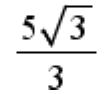
- (d)Option (d) shows 5√3 ⁄ 3, whose square is 75 ⁄ 9, about 8.3. Neither part survives — the numerator is 45 and the denominator 25.
Concept
Two identities do the whole job, and the question is built to hide the first one.
sin(90° − θ) = cos θ and cos(90° − θ) = sin θ. So 64° is the complement of 26°, and 58° is the complement of 32°.
Once rewritten, each pair becomes sin²θ + cos²θ = 1, and the whole expression is arithmetic.
The habit worth building is to add the angles the moment you see two of them in one expression. If they sum to 90°, they are the same ratio in disguise.
Nothing here needs a value in degrees. Two angle sums of 90° are the entire question, and trying to evaluate sin 26° numerically only costs time.
Key facts
- sin(90° − θ) = cos θ and cos(90° − θ) = sin θ.
- sin²θ + cos²θ = 1 for every angle θ.
- 26° + 64° = 90°, so sin²26° + sin²64° = 1.
- 32° + 58° = 90°, so cos²32° + cos²58° = 1.
Study next
Common traps
- Reaching for a calculator value of sin 26° instead of pairing it with sin 64°.
- Pairing across the fraction bar — 26° with 32°, say — when neither sum reaches 90°.
- Simplifying √(45 ⁄ 25) to √45 ⁄ 5 and stopping there, without reducing √45 to 3√5.
SSC also asks the complementary-angle rule on its own, with no Pythagorean step. "Express sin 74° + tan 74° in terms of trigonometric ratios of angles between 0° and 45°" runs at 11 Sep 2024, 16:00, Quant Q.7.
The equation form appears at 26 Sep 2024, 09:00, Quant Q.10, where sin(48° + k) = cos 13° has to be solved for k.
Related PYQs
No directly related past PYQ was found.