
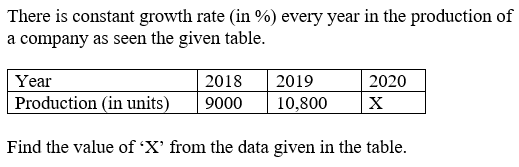
There is constant growth rate (in %) every year in the production of a company as seen the given table. Year → 2018 | 2019 | 2020 Production (in units) — 9000 | 10,800 | X Find the value of ‘X’ from the data given in the table.
- (a)12960
- (b)11880
- (c)12600
- (d)12000
Answer
Why
Correct — A. The stem is an image: a table giving production of 9000 units in 2018, 10,800 in 2019 and X in 2020, with a constant growth rate every year.
Constant rate means each year is the previous year multiplied by the same factor.
Factor = 10800 ⁄ 9000 = 1.2, that is a growth rate of 20%
X = 10800 × 1.2
= 10800 + 2160 = 12960
So X = 12960 units → option (a).
Why the others are wrong
- (b)11880 — 11880 is 10800 grown by 10%. The step the table actually shows, 9000 to 10800, is a rise of 20%, not 10%.
- (c)12600 — 12600 adds the same absolute rise of 1800 units again. The table fixes the rate as constant, not the increment.
- (d)12000 — 12000 needs a factor of 10⁄9, about 11.1% — the factor that would turn 9000 into 10000. The table's factor is 1.2.
Concept
A constant growth rate makes the yearly figures a geometric progression: you multiply by (1 + r) each year, you do not add a fixed amount.
So two consecutive known years are enough. Their ratio is the common factor, and every later year follows from it — production in year n = P(1 + r)ⁿ.
The rival reading, a constant increase, makes an arithmetic progression instead: 9000, 10800, 12600. Both are consistent with the two known cells, which is why the phrase "growth rate (in %)" is doing real work in the stem.
Take the percentage on the base year, not on the later one. 1800 is 20% of 9000 but only about 16.7% of 10,800, and that slip changes the answer.
Key facts
- A constant growth rate multiplies each year by the same factor, giving a geometric progression.
- 10800 ⁄ 9000 = 1.2, so the annual growth rate is 20%.
- The sequence 9000, 10800, 12960 has common ratio 1.2.
- A constant absolute increase would instead give 9000, 10800, 12600.
Study next
Common traps
- Adding 1800 a second time, which assumes a constant increase rather than a constant rate.
- Computing the rate as 1800 ⁄ 10800 instead of 1800 ⁄ 9000.
- Taking 20% of 9000 and adding it to 10,800.
Percentage change is set in several disguises. As a chain of rises and falls — 18% up, then 15% down, then 3% down on ₹2,00,000 — at Quant Q.6 of this shift.
As a discount to be reversed at Quant Q.4 of this shift, where ₹1,792 after 20% off has to be turned back into the marked price.
Related PYQs
No directly related past PYQ was found.