
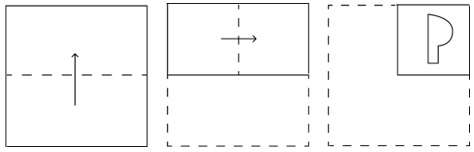
A paper is folded and cut as shown below. How will it appear when unfolded?
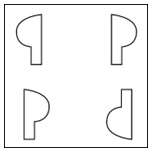
- (a)
- (b)
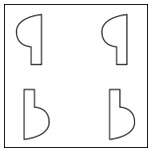
- (c)
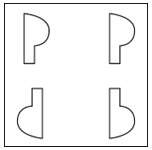
- (d)
Answer
Why
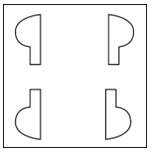
Correct — D. The sheet is folded twice: the bottom half up onto the top, then the left half right onto what remains. The cut sits in the top-right quarter and is shaped like a letter P, an upright stem with the bowl opening right.
Unfolding reverses that, and a fold is a mirror. Opening the vertical crease copies the P left to right into the top-left quarter. Opening the horizontal crease copies both top to bottom into the lower quarters.
So the sheet must be symmetric about both centre lines, and option (d) alone shows it: the upright P at top right, its left-right mirror at top left, and both turned over below.
Why the others are wrong
- (a)Its lower-left copy is still an upright P rather than the top-to-bottom mirror the horizontal fold demands. A fold reverses the shape, it does not slide it down the page.
- (b)The two copies in each row are identical, not mirrored. That is what sliding the cut sideways would produce, never what opening a fold about the vertical centre line produces.
- (c)Its top row prints the same P twice. Opening the left-onto-right fold has to reverse the copy it creates, so the top-left P must face the other way.
Concept
A fold is a reflection. Every time you open one, the cut is copied across the crease as a mirror image, never as a shifted duplicate.
Two folds therefore give four copies, and the opened sheet is symmetric about both creases. The folds here were bottom onto top and left onto right, so the creases are the horizontal and vertical centre lines.
That turns the question into one about orientation rather than position: the four copies must face each other in pairs across each centre line.
The cut chosen has no line of symmetry of its own, which is what lets the options be told apart at all.
All four options place their shapes in the same four quarters, so position decides nothing. Only which way each copy faces separates them, and that is the part the folding rule fixes.
Key facts
- Opening a fold reflects the cut across the crease, so each copy is a mirror image.
- Two folds produce four copies, arranged symmetrically about both creases.
- The creases here are the horizontal and vertical centre lines of the square sheet.
- The cut is a P, which has no axis of symmetry, so its orientation alone identifies the answer.
Study next
Common traps
- Copying the shape instead of mirroring it, which is what option (b) shows
- Getting the vertical mirror right and forgetting the horizontal one, as option (a) does
- Checking where the four shapes sit rather than which way each one faces
The same three-panel layout — a solid square, a dashed crease with an arrow, then the cut drawn on the folded quarter — is used at 11 Sep 2024, 09:00, Reasoning Q.15 and Q.18, and both reward the same mirror-not-slide reading.
Related PYQs
No directly related past PYQ was found.