
Identify the figure given in the options which when put in place of ? will logically complete the series.
- (a)
- (b)
- (c)
- (d)
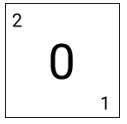
Answer
Why
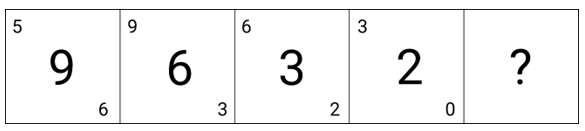
Correct — D. The strip shows five boxes. Each carries a small number at the top left, a large number in the centre and a small number at the bottom right.
Reading them out: 5 | 9 | 6, then 9 | 6 | 3, then 6 | 3 | 2, then 3 | 2 | 0, then the box marked ?.
Rule: the three numbers in a box are three consecutive entries of one running list, and the window slides one entry per box. The list the four boxes spell out is 5, 9, 6, 3, 2, 0.
Box 4 is 3 | 2 | 0, so the missing box has to open 2 at the top left and carry 0 in the centre. That rules out option (a) and option (c), which put 0 above 2.
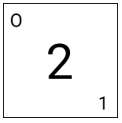
That leaves two boxes with the same first two cells, differing only in the bottom-right digit — the seventh entry of the list, which the four printed boxes never reach. The key marks it 1, which is option (d).
Why the others are wrong
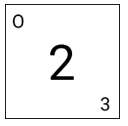
- (a)It shows 0 at the top left and 2 in the centre — the two numbers the wrong way round. The top left has to repeat box 4's large number, which is 2, and the centre takes box 4's corner number, 0.
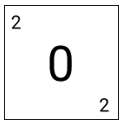
- (b)Its top-left 2 and centre 0 are right, and only the bottom-right digit separates it from the keyed box. That cell is the list's seventh entry, which the strip never reaches; the key puts 1 there, not 2.
- (c)The same reversal as option (a): 0 above 2 instead of 2 above 0. Once the first two numbers are in the wrong slots the bottom-right 1 cannot rescue it.
Concept
Number-in-a-box series usually hide one running list. Here the list is 5, 9, 6, 3, 2, 0 and each box shows three consecutive entries — top-left first, then the large centre number, then the bottom-right.
Slide one box to the right and the window slides one entry along the list. That is why 9 is a large number in box 1 and a small corner number in box 2.
Reading only the large numbers and treating the corners as decoration is what makes this item look unsolvable. The corners are the series.
Options (b) and (d) both place 2 at the top left and 0 in the centre, and differ only in the bottom-right digit — the entry that would be the large number of a sixth box the strip never draws.
The four boxes on the page do not pin that entry down on their own, and the key settles it at 1. Eliminate on the two cells you can prove and mark the survivor.
Key facts
- Box 1 reads 5, 9, 6 and box 2 reads 9, 6, 3, so box 2 begins with box 1's centre number.
- Box 3 reads 6, 3, 2 and box 4 reads 3, 2, 0, the same one-place slide again.
- Options (a) and (c) both carry 0 at the top left, which no box after box 4 can have.
Study next
Common traps
- Comparing only the large centre numbers and ignoring the corner digits
- Assuming each box must be self-contained, with its three numbers related to one another
- Choosing an option on the strength of its first correct cell
The stem names the task — 'Identify the figure given in the options which when put in place of ? will logically complete the series' — but describes nothing in the pictures, so the rule has to be read off the figures.
Reasoning Q.13 of this same 18 Sep 2024, 16:00 paper is another figure series worked by a different rule: symbols move between the corners and the middle row inside each figure, rather than a window sliding from box to box.
Related PYQs
No directly related past PYQ was found.