
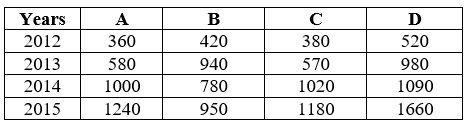
Study the given table and answer the question that follows. The table represents the number of scooters (in thousands) manufactured by four companies A, B, C and D from the period 2012 to 2015. The average number of scooters produced by company D is what per cent (rounded off to 2 decimal places) more than the combined average number of scooters produced by the three companies A, B, and C?
- (a)52.75%
- (b)35.35%
- (c)44.66%
- (d)27.25%
Answer
Why
Correct — B. Take the four column totals off the table first.
A = 360+580+1000+1240 = 3180
B = 420+940+780+950 = 3090
C = 380+570+1020+1180 = 3150
D = 520+980+1090+1660 = 4250
D's average = 4250 ⁄ 4 = 1062.5
A, B and C together = 9420 spread over 12 entries = 9420 ⁄ 12 = 785
Excess = 1062.5 − 785 = 277.5
277.5 ⁄ 785 = 0.353503… → 35.35% → option (b)
Why the others are wrong
- (a)52.75% — For 52.75% the base would have to be about 695.6, since 1062.5 ⁄ 1.5275 = 695.6. The three companies' twelve figures average 785, so the excess is nothing like that large.
- (c)44.66% — 44.66% needs a base of about 734.5 (1062.5 ⁄ 1.4466). No reading of the table produces 734.5 — the A, B and C figures give exactly 785.
- (d)27.25% — 27.25% needs a base near 835. Even the commonest base error, dividing the 277.5 gap by D's own 1062.5, comes to 26.12% rather than 27.25%.
Concept
Two ideas meet here, and the arithmetic is the easy half.
"X is p% more than Y" always puts the quantity named after "than" in the denominator. The base is the combined A-B-C average, never D's.
The combined average of three companies over four years is their grand total divided by all twelve entries: 9420 ⁄ 12 = 785. Dividing by 4 instead would give the combined annual output of the three, a different quantity altogether.
The phrase "combined average" can be read two ways, and here both give the same number.
Total over twelve entries is 9420 ⁄ 12 = 785. Averaging the three companies' own averages — 795, 772.5 and 787.5 — also gives 785, because each company has the same four years behind it. The ambiguity costs you nothing on this question.
Key facts
- "X is p% more than Y" means p = (X − Y) ⁄ Y × 100, so the quantity named after "than" is the base.
- Company D averages 4250 ⁄ 4 = 1062.5 thousand scooters over 2012 to 2015.
- The combined average of A, B and C is 9420 ⁄ 12 = 785, not 9420 ⁄ 4 = 2355.
- The table is in thousands throughout, and a percentage comparison is unaffected by a shared unit.
Study next
Common traps
- Dividing the A+B+C total by 4 instead of 12, which turns a 35.35% rise into a 54.88% fall.
- Using D's own average as the base, which gives 26.12%.
- Rounding to 35.4% and then failing to find it among four two-decimal options.
SSC builds a small table, then asks one derived comparison from it — which company has the highest average at 9 Sep 2024, 16:00, Quant Q.11, and one total as a percentage of another at Quant Q.15 of this paper. The reading is never the difficulty. The denominator the wording asks for is.
Related PYQs
No directly related past PYQ was found.