
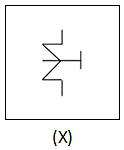
Select the option figure in which the given figure (X) is embedded (rotation is NOT allowed).
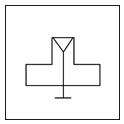
- (a)
- (b)
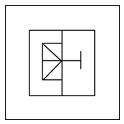
- (c)
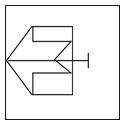
- (d)
Answer
Why
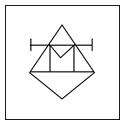
Correct — B. Rotation is barred, so every line of figure (X) has to reappear at the same angle and the same length.
Figure (X) is a right-pointing arrowhead whose apex sits on a horizontal line. That horizontal runs a short way left of the apex and a longer way right, ending in a small vertical tick.
From the arrowhead's upper tip a short horizontal runs right and then turns up. From the lower tip a short horizontal runs right and then turns down.
Option (b) holds all of it. The two slanting sides meet at an apex on the inner vertical line, the horizontal through that apex ends in the same right-hand tick, and the two short horizontals run into that vertical, which continues up above and down below.
Why the others are wrong
- (a)Option (a) is built from rectangles with a downward-pointing V at the top and a vertical stem below. Nothing in it points right, so (X)'s arrowhead has nowhere to sit.
- (c)Option (c) carries the same tick-ended horizontal, but both of its arrowheads point left. Turning (X) round would fix that, and the stem forbids rotation.
- (d)Option (d) is a triangle over a diamond, and its horizontal carries a tick at both ends. (X) has a tick at one end only, so the two drawings do not correspond.
Concept
An embedded-figure item asks whether the target's lines can be found inside a busier drawing without moving them. The option usually hides (X) by adding lines that continue (X)'s own strokes, so the eye reads a different shape.
Work outwards from the rarest feature. Here that is the tick — a short vertical crossing the end of a horizontal — and only once you have located it is it worth checking the arrowhead and the two turned stubs.
When the stem bars rotation, orientation settles most options on its own, and it is the cheapest test to run first.
The tick-ended horizontal appears in both (b) and (c), so it is orientation, not the tick, that separates them.
Key facts
- Figure (X) is a right-pointing arrowhead on a horizontal line that ends in a short vertical tick.
- Option (b) adds an outer rectangle and a full-height vertical that disguise (X) without altering any of its lines.
- The stem bars rotation, so option (c)'s left-pointing arrowheads cannot count as a match.
Study next
Common traps
- Accepting an option because it contains a triangle, without checking which way the triangle points.
- Ignoring the rotation bar and mentally turning (X) to make option (c) fit.
- Matching the outline of (X) instead of each of its separate line segments.
SSC prints this stem word for word in other shifts and changes only the target figure. 17 Sep 2024, 12:30, Reasoning Q.3 and Q.20 both carry it, and so does 18 Sep 2024, 16:00, Reasoning Q.21.
Related PYQs
No directly related past PYQ was found.