
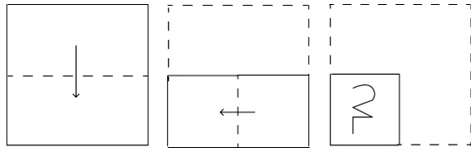
A paper is folded and cut as shown below. How will it appear when unfolded?
- (a)
- (b)
- (c)
- (d)
Answer
Why
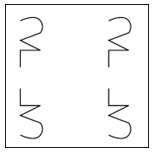
Correct — D. Rule: undo each fold as a mirror, in reverse order, about that fold line.
Panel 1 folds the top half down onto the bottom half. Panel 2 folds the right half left onto the left half. What is left is the bottom-left quarter, four layers thick.
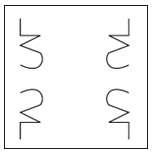
So one cut prints four times. The bottom-left copy is the cut exactly as drawn. The bottom-right copy is its mirror across the vertical centre line. The top two are those two mirrored across the horizontal centre line.
Option (d) is the one where left and right face opposite ways, top and bottom face opposite ways, and the bottom-left copy matches panel 3.
Why the others are wrong
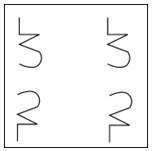
- (a)Option (a) mirrors top against bottom correctly, but the two copies in each row face the same way. Opening the vertical fold has to turn the right-hand copy into a mirror image of the left.
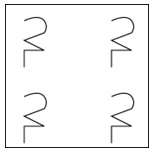
- (b)In option (b) all four copies are identical. That is what stamping the cut four times would give, not unfolding, since each fold reverses the copy it opens out.
- (c)Option (c) is wrong twice. It puts the copy matching panel 3 in the top-left quarter, where the folds leave it at the bottom-left, and its two copies in each row face the same way instead of mirroring.
Concept
Unfolding is folding run backwards, one step at a time.
Undo the last fold first. That one was right onto left, so open it out to the right and draw everything mirrored across the vertical crease.
Then undo the first fold. That was top onto bottom, so open it upward and mirror everything across the horizontal crease.
Two perpendicular folds always leave a pattern with both a vertical and a horizontal axis of symmetry, and an option missing either one is out.
Panel 3 draws the cut inside the bottom-left quarter with the rest of the sheet dashed in, which tells you where the untouched copy has to land. Use that as your first filter, before you check any mirroring.
Key facts
- Two folds make four layers, so a single cut produces four copies.
- Each fold is undone as a mirror image about its own fold line, in reverse order.
- Folding top down and then right left leaves the bottom-left quarter on top, so the bottom-left copy reproduces the cut as drawn.
Study next
Common traps
- Repeating the cut instead of mirroring it, which makes all four copies identical.
- Undoing the first fold first instead of the last.
- Putting the unmirrored copy in the wrong quarter of the sheet.
The same stem runs elsewhere in the same paper at Reasoning Q.20, and again on 18 Sep 2024, 16:00, Reasoning Q.20 and on 17 Sep 2024, 12:30, Reasoning Q.4.
The folds change from paper to paper. Undoing them as mirrors in reverse order does not.
Related PYQs
No directly related past PYQ was found.