
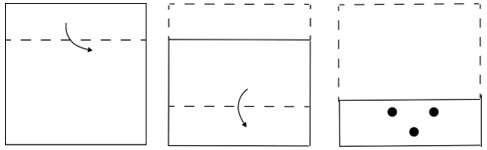
A square sheet of paper is folded along the dotted line successively along the directions shown and is then punched in the last as shown. How would the paper look when unfolded?
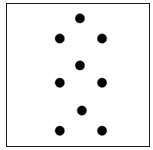
- (a)
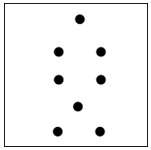
- (b)
- (c)
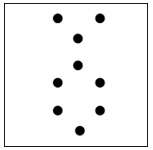
- (d)
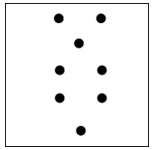
Answer
Why
Correct — C. Rule: unfolding mirrors every hole across each crease, in reverse fold order.
The sheet is creased into three horizontal bands. The top band folds down onto the middle band, then that two-layer flap folds down onto the bottom band, so the punch cuts three layers and nine holes open up.
The bottom band was never folded, so it must reproduce the punched picture exactly: two holes side by side with a third below them, centred.
Undo the second fold and that group reappears in the middle band flipped — single above pair. Undo the first fold and it flips back, so the top band is upright again.
Option (c) is the figure that reads pair-then-single, single-then-pair, pair-then-single from top to bottom.
Why the others are wrong
- (a)Option (a) also carries nine holes, but every band is inverted — the single hole sits above the pair. Its bottom band therefore contradicts the punched picture, where the pair is on top.
- (b)Option (b) shows only eight holes, so one layer has lost a punch. Its bottom band also puts the single hole above the pair, the reverse of what was punched.
- (d)Option (d) shows eight holes as well. Its middle band carries a pair where the mirrored group needs a single hole, so it is misplaced as well as incomplete.
Concept
Paper-folding questions are solved backwards. Start from the punched figure and undo the folds in reverse order, mirroring every hole across the crease you are undoing.
Count layers first. Each fold that lands one band on another adds a layer under the punch, and the number of layers is the number of copies of the punched group that appear when the sheet is open.
A horizontal crease changes only the vertical position of a hole. Its distance from the left edge is untouched, which is why all nine holes here stand on just three vertical lines.
The creases in the stem are drawn schematically, so do not try to measure the strips. Work from the last picture instead: a three-hole group reproduced nine times means the punch passed through three layers.
Key facts
- Unfolding reverses the folds: the last fold made is the first one undone.
- A hole mirrors across the crease being undone, and its distance from the left edge does not change.
- Three layers under the punch produce three copies of a three-hole group, so nine holes.
- The band that was never folded shows the punched pattern in its original orientation.
Study next
Common traps
- Undoing the folds in the order they were made instead of reversing them.
- Copying the punched group upright into every band instead of alternating the flip.
- Counting the holes and stopping there, without checking their orientation band by band.
Paper-folding also appears at 9 Sep 2024, 12:30, Reasoning Q.20 and at 13 Sep 2024, 09:00, Reasoning Q.23 — a square sheet, successive folds along dotted lines, a punch at the end.
Related PYQs
No directly related past PYQ was found.