
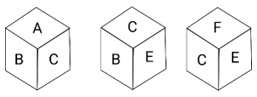
Six letters A, B, C, D, E and F are written on different faces of a dice. Three positions of this dice are shown in the figure. Find the letter on the face opposite to A.
- (a)D
- (b)C
- (c)E
- (d)F
Answer
Why
Correct — C. The three views show A on top with B and C in front, C on top with B and E in front, and F on top with C and E in front.
Rule: two faces seen together in one view can never be opposite. Collect the neighbours, then pair off what is left.
C is seen with A and B, then with B and E, then with F and E — four different neighbours. The one letter it never appears beside is D, so C is opposite D.
B is seen with A and C, then with C and E. Its partner must be D or F, and D is already taken, so B is opposite F.
A and E are the two letters left over, so the face opposite A is E — option (c).
Why the others are wrong
- (a)D — D never shows in any view, which makes it look like A's hidden partner. It is hidden because it lies opposite C, and C is visible in all three views.
- (b)C — A and C sit side by side in the first view, and two faces seen at once are adjacent, never opposite. This one can be struck out before any deduction begins.
- (d)F — F is B's partner, not A's. B is seen beside A, C and E, so its opposite is D or F, and D already belongs to C.
Concept
A cube has three pairs of opposite faces, and any one view shows three faces that are all adjacent to each other. So each view is really a statement that those three letters are pairwise non-opposite.
Collect those exclusions across the views. A letter with four known neighbours has its opposite settled at once — only one letter can be left. After that, elimination finishes the job: once two pairs are fixed, the two remaining letters must form the third.
You never need to work out how the die was turned between views. The neighbour lists settle it on their own, and they are far less error-prone than tracking a rotation in your head.
Key facts
- Each view of a cube shows three mutually adjacent faces, so no two letters in one view can be opposite.
- C is seen alongside A, B, E and F, which leaves D as its only possible opposite.
- The three pairs on this die are A-E, B-F and C-D.
Study next
Common traps
- Trying to rotate the cube in your head when the neighbour lists already decide it.
- Choosing the letter that never appears, on the assumption that the hidden face must be the answer.
- Overlooking that a letter repeated across views brings a fresh neighbour with each appearance.
SSC gives three views of one die and asks for a single opposite face, with the letter that appears in none of the views planted as an option. Reading the views as neighbour lists is the whole method.
Related PYQs
No directly related past PYQ was found.