
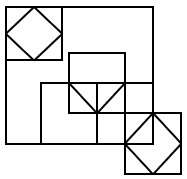
How many triangles are there in the figure shown below?
- (a)11
- (b)9
- (c)12
- (d)14
Answer
Why
Correct — D. The figure is three drawn blocks laid over one large square, so count block by block and keep a running total.
Rule: count each block on its own, then look for triangles whose sides come from two different blocks.
Top-left: a small square with a diamond on its four midpoints. The diamond cuts off 4 corner triangles. Total 4.
Middle: a square whose lower part carries a vertical median and two lines running from its top corners down to the midpoint of its base. Two small triangles either side of the median, the large one they combine into, and one more against each side wall — 5. Total 9.
Bottom-right: a second square with its own inscribed diamond, 4 corner triangles. Total 13.
Now the straddler. The big square's right edge and bottom edge meet at its bottom-right corner, and the diamond's upper-left side cuts across them — 1 more.
4 + 5 + 4 + 1 = 14 — option (d).
Why the others are wrong
- (a)11 — 11 is 4 + 4 plus only the three obvious triangles of the middle block. It misses the two formed against that block's side walls, and the straddling one at the big square's corner.
- (b)9 — 9 is 4 + 4 plus the single large triangle in the middle block. That block holds five, not one, once the median and the side walls are used.
- (c)12 — 12 is two short. The pair most often missed is the two triangles leaning on the middle block's left and right walls, where a slant line meets the base.
Concept
A counting figure is built by superimposing simple units, and the count is only reliable if you break it back into those units. Here they are a square with an inscribed diamond, a square carrying a median and two slant lines, and a second square with an inscribed diamond.
A square with a diamond on its four midpoints gives exactly four triangles and never more, because no two of its corner triangles share an edge and so none of them combine.
The block totals here come to 13. The fourteenth is the one that block-by-block counting can never find, because two of its sides belong to the outer square and the third to a diamond.
Count in a fixed order and write the running total down as you go. Recounting from scratch is how a candidate reaches 12 once and 13 the next time and then picks whichever is on the list.
Key facts
- A square with a diamond drawn on its four midpoints contains exactly four triangles, one at each corner.
- The middle block — a square cut across at mid-height, carrying a vertical median below the cut and two lines from the ends of that cut down to the midpoint of the base — contains five triangles.
- The fourteenth triangle takes two sides from the outer square's edges and its third from a diamond side, so no single block contains it.
Study next
Common traps
- Stopping at the block-by-block total and never hunting for a triangle spanning two blocks.
- Missing the two triangles against the middle block's side walls, because the eye follows the V and skips the base.
- Expecting a diamond inside a square to yield more than four triangles by combining corners.
SSC sets counting figures whose options sit close together — 9, 11, 12 and 14 here — so a single missed triangle changes the answer. The same patience with a figure decides the embedded-figure item at Reasoning Q.24 of this shift.
Related PYQs
No directly related past PYQ was found.