
Identify the figure given in the options, which when put in place of the question mark (?) will logically complete the series.
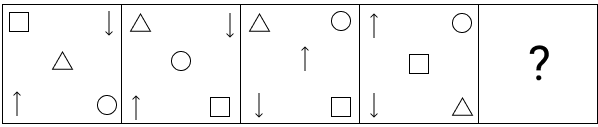
- (a)
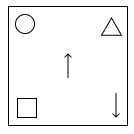
- (b)
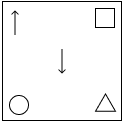
- (c)
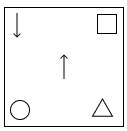
- (d)
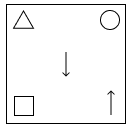
Answer
Why
Correct — B. Five symbols sit in five fixed slots — top-left, top-right, centre, bottom-left, bottom-right. Nothing enters or leaves the frame, and only three symbols move at each step.
Rule: the two diagonals take turns.
Steps 1→2 and 3→4 move the main diagonal (top-left, centre, bottom-right).
Steps 2→3 and 4→5 move the other diagonal (top-right, centre, bottom-left).
On whichever diagonal is moving, each symbol shifts one place towards the top end, and the one already at the top wraps round to the bottom.
Figure 4 reads: up-arrow, circle, square, down-arrow, triangle.
Step 4→5 moves the top-right / centre / bottom-left diagonal, so top-left and bottom-right are untouched — the up-arrow and the triangle stay where they are.
The circle drops from top-right to bottom-left.
The square climbs from centre to top-right.
The down-arrow climbs from bottom-left to centre.
That gives up-arrow, square, down-arrow, circle, triangle — option (b).
Why the others are wrong
- (a)Every one of the five slots has changed in option (a), which no single-diagonal move can do. The top-left and bottom-right corners sit off the moving diagonal and must still hold the up-arrow and the triangle.
- (c)Option (c) swaps the two arrows. The up-arrow belongs at top-left, a slot this step does not touch, and the down-arrow has to climb from bottom-left into the centre — so the moving diagonal is wrong at its centre slot too.
- (d)Option (d) leaves the circle at top-right, but the circle lies on the moving diagonal and has to drop to bottom-left. It also shifts the triangle, which this step leaves alone.
Concept
Nothing is added, removed or redrawn across these five frames — the same five symbols occupy the same five slots throughout. So the series is about position, not about shape, and the way to read it is to pick one symbol and follow its slot from frame to frame.
Do that for the square and you get top-left, bottom-right, bottom-right, centre. The repeat is the clue: a slot only changes on the steps when its own diagonal is the one being moved.
The centre is the one slot shared by both diagonals, so it changes at every step while each corner changes on alternate steps. Checking the centre first tells you which diagonal is moving.
Key facts
- All five frames carry the same inventory — a square, a triangle, a circle, an up-arrow and a down-arrow.
- The main diagonal of this layout is top-left, centre, bottom-right. The other is top-right, centre, bottom-left.
- The centre lies on both diagonals, so it changes at every step of the series.
- A corner changes only on the steps when the diagonal through it is the one being moved.
Study next
Common traps
- Comparing the inventory of symbols between frames, which never changes and so cannot decide anything.
- Assuming a single rotation runs through the whole series when the rule alternates between two diagonals.
- Treating the centre as fixed furniture, when it is the slot that moves at every single step.
SSC prints four framed cells and a fifth blank one and asks for a slot-to-slot transformation, never a change of shape. The same 'complete the series' instruction heads the letter-grid item at Reasoning Q.25 of this shift.
Related PYQs
No directly related past PYQ was found.