
Identify the figure from among the given options which when put in place of the question mark (?) will logically complete the series.
- (a)
- (b)
- (c)
- (d)
Answer
Why
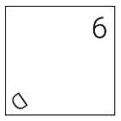
Correct — D. Each box in the series carries exactly two marks: one at the top-right, one at the bottom-left.
Rule: a box's top-right mark returns at the bottom-left of the next box, flipped left to right, while a fresh mark takes the top-right corner.
Box 1's L returns in box 2 with its upright on the right and its foot pointing left.
Box 2's P returns in box 3 as q — mirrored, the bowl moves to the upper left and the stem runs down the right side.
Box 3's 7 returns in box 4 with the bar still on top but the stroke falling to the right.
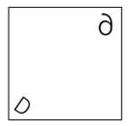
Box 4's top-right holds a D-shape whose straight edge lies on the upper left. Flipped, that straight edge lies on the upper right with the bulge at the lower left, and a fresh 6 takes the top-right corner — option (d).
Why the others are wrong
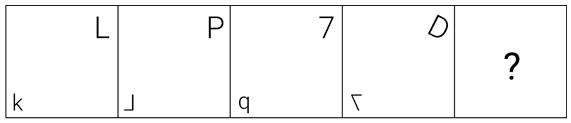
- (a)The pair is right, but a stray k sits in the middle. Every box in the series carries two marks, and that k belongs to box 1's bottom-left corner.
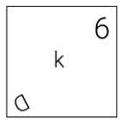
- (b)The two marks are in swapped corners — the D-shape at the top-right and the 6 at the bottom-left. The carried-over mark travels to the bottom-left, and it arrives flipped.
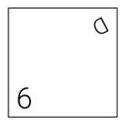
- (c)The flip lands on the wrong mark. Here the 6 is reversed while the D-shape at the bottom-left keeps the orientation it had in box 4; it is the carried-over mark that flips.
Concept
When a picture series shows a few letters and numerals sitting in fixed corners, look for a carry-over: a mark that reappears in the next box, somewhere else and changed.
Test the change on a character whose mirror is a different, nameable shape. P is the giveaway here — flipped left to right it reads as q, which is not what a turn would give.
Rotation and reflection part company on exactly those characters, so pick your test case before deciding which of the two the series uses.
The fresh mark that appears at each box's top-right cannot be predicted from the series. The option is settled by the bottom-left mark and by there being two marks and no more.
Key facts
- Each stem box carries two marks, one at the top-right and one at the bottom-left.
- A box's top-right mark reappears at the bottom-left of the next box, reflected left to right.
- Mirroring P gives q, with the bowl at the top and the stem descending on the right.
- Turning P through 180 degrees instead leaves the bowl at the bottom with the stem rising above it, which is not what box 3 shows.
Study next
Common traps
- Choosing the box whose shapes are right but which carries three marks instead of two.
- Testing the rule on m or on any symmetrical shape, which looks the same under either operation.
- Flipping the fresh mark instead of the one that carries over.
Lateral inversion also decides the mirror-at-MN items at Reasoning Q.7 and Q.23 of this shift. Both turn on which characters change under a left-right flip and which are unaltered by it.
Related PYQs
No directly related past PYQ was found.