
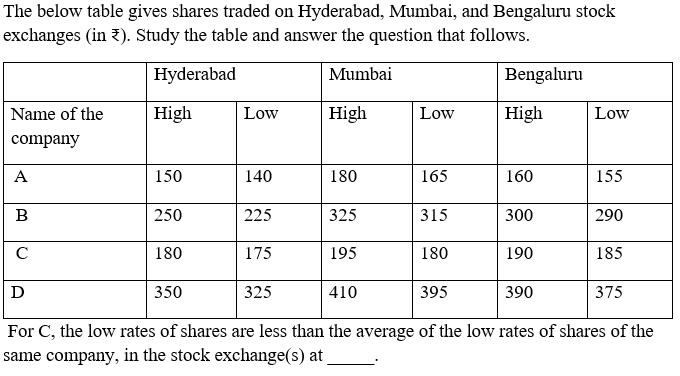
The below table gives shares traded on Hyderabad, Mumbai, and Bengaluru stock exchanges (in ₹). Study the table and answer the question that follows. Name of the company → Hyderabad High | Hyderabad Low | Mumbai High | Mumbai Low | Bengaluru High | Bengaluru Low A — 150 | 140 | 180 | 165 | 160 | 155 B — 250 | 225 | 325 | 315 | 300 | 290 C — 180 | 175 | 195 | 180 | 190 | 185 D — 350 | 325 | 410 | 395 | 390 | 375 For C, the low rates of shares are less than the average of the low rates of shares of the same company, in the stock exchange(s) at ______.
- (a)Hyderabad
- (b)Bengaluru
- (c)Mumbai
- (d)Hyderabad and Mumbai
Answer
Why
Correct — A. The stem is a picture of a table of High and Low share rates on three exchanges. Only company C's Low row matters.
C's Low rates: Hyderabad 175, Mumbai 180, Bengaluru 185
Average = (175 + 180 + 185) ⁄ 3 = 540 ⁄ 3 = 180
Now apply "less than 180":
Hyderabad 175 is below 180, so it qualifies.
Mumbai 180 equals 180, so it is not less and drops out.
Bengaluru 185 is above 180, so it drops out.
Hyderabad alone survives → option (a).
Why the others are wrong
- (b)Bengaluru — Bengaluru's Low for C is 185, the highest of the three. It sits above the average of 180, so it fails a 'less than' test rather than passing it.
- (c)Mumbai — Mumbai's Low for C is exactly 180, which is the average itself. 'Less than' excludes equality, so Mumbai misses by nothing at all — this is the reading the item is built to catch.
- (d)Hyderabad and Mumbai — This pairs the correct city with the borderline one. It would be right only if 180 were less than 180, and it is not.
Concept
The table carries a two-tier header: three exchanges across the top, each split into High and Low underneath, with the companies A to D down the side.
So a single cell needs three coordinates — company, exchange, and High or Low. The arithmetic is one row average and three comparisons. What decides the answer is the word less, which is strict and rules out the value equal to the mean.
The average of C's three Low rates lands exactly on one of them, ₹180 at Mumbai. That coincidence is the whole design of the question, and it is why an option offering two cities is on the list.
Key facts
- For company C the Low rates read Hyderabad ₹175, Mumbai ₹180 and Bengaluru ₹185.
- Their average is ₹180, which coincides exactly with Mumbai's Low rate.
- 'Less than the average' is strict, so a value equal to the average does not qualify.
- C's High rates are Hyderabad ₹180, Mumbai ₹195 and Bengaluru ₹190 — a different set, and not what this item asks for.
Study next
Common traps
- Averaging C's High rates (180, 195, 190) instead of its Low rates. The two-tier header makes the wrong column easy to grab.
- Counting Mumbai because ₹180 'is the average'. The wording is 'less than', not 'at most'.
- Averaging down a neighbouring company's row. C is the third of the four rows, between B and D.
This item is light on arithmetic — one row, one average, one comparison — and heavy on lifting the right cells out of a two-tier header.
Comparable tables appear at 9 Sep 2024, 09:00, Quant Q.16 (candidates appeared against candidates present by centre), 18 Sep 2024, 16:00, Quant Q.15 (company expenditure by year) and 24 Sep 2024, 12:30, Quant Q.4 (zone-wise tea survey).
Related PYQs
No directly related past PYQ was found.