
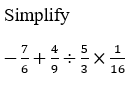
Simplify −7⁄6 + 4⁄9 ÷ 5⁄3 × 1⁄16
- (a)

- (b)

- (c)

- (d)

Answer
Why
Correct — B. The stem is a picture: simplify −7⁄6 + 4⁄9 ÷ 5⁄3 × 1⁄16.
BODMAS puts division and multiplication ahead of the addition, and those two run left to right.
4⁄9 ÷ 5⁄3 = 4⁄9 × 3⁄5 = 12⁄45 = 4⁄15
4⁄15 × 1⁄16 = 4⁄240 = 1⁄60
Now the addition, over LCM 60:
−7⁄6 + 1⁄60 = −70⁄60 + 1⁄60 = −69⁄60
Divide top and bottom by 3 → −23⁄20, the fraction pictured in option (b).
Why the others are wrong
- (a)Option (a) shows −18⁄23 with the 23 underneath. Here 23 is born as 69 ÷ 3 and stays in the numerator, over 60 ÷ 3 = 20. No step produces an 18.
- (c)Option (c) shows −23⁄18. The numerator is right but 18 appears nowhere: the addition is done over LCM 60, and 69⁄60 reduces to 23⁄20.
- (d)Option (d) shows −20⁄23, the keyed fraction inverted. Taking a reciprocal is the move used on 5⁄3 inside the division, not something applied to the final value.
Concept
Two rules carry this item. Division outranks addition, so 4⁄9 ÷ 5⁄3 × 1⁄16 is settled before −7⁄6 is brought in.
And division and multiplication sit on the same rank, so they are worked strictly left to right. Dividing by a fraction means multiplying by its reciprocal, which is where 3⁄5 comes from. Only then does the negative fraction join, over a common denominator.
Every printed choice is negative and every one carries a 23, an 18 or a 20, so eyeballing the sign or the numerator will not separate them. The denominator is what the working has to pin down.
Key facts
- Division and multiplication share one precedence level and are performed left to right.
- Dividing by 5⁄3 is the same as multiplying by 3⁄5.
- 4⁄9 ÷ 5⁄3 × 1⁄16 = 1⁄60, and −7⁄6 + 1⁄60 = −69⁄60 = −23⁄20.
Study next
Common traps
- Adding −7⁄6 and 4⁄9 first. BODMAS forbids it, and the value it produces is not among the four printed fractions.
- Computing 5⁄3 × 1⁄16 before the division, on the belief that multiplication outranks division.
- Leaving the result as −69⁄60 and hunting for it among the choices. All four pictures are in lowest terms, so the reduction by 3 has to be done before comparing.
SSC types this item as an image: the expression is set as stacked fractions and each of the four choices is its own picture.
So the first task is transcribing it without dropping the minus sign or misreading which operator sits between which pair. What the question really tests is the rank of ÷ against ×.
Related PYQs
No directly related past PYQ was found.