
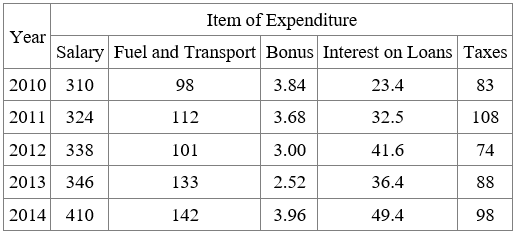
Study the following table and answer the question that follows. Expenditures of a Company (in Lakh Rupees) Per Annum over Different Heads in the Given Years The total amount of bonus paid by the company during the given period is approximately what percentage of the total amount of salary paid during this period? (Rounded off to the nearest integer.)
- (a)1.5%
- (b)1%
- (c)2.5%
- (d)2%
Answer
Why
Correct — B. Add the bonus column across 2010-2014:
3.84 + 3.68 + 3.00 + 2.52 + 3.96 = 17.00 lakh
Add the salary column:
310 + 324 + 338 + 346 + 410 = 1728 lakh
Percentage = (17 ÷ 1728) × 100
= 1700 ÷ 1728
= 0.98%
Rounded to the nearest integer that is 1% — option (b).
Why the others are wrong
- (a)1.5% — 1.5% would need a bonus total near 25.9 lakh, half again what the column adds to. The stem also asks for the answer rounded to the nearest integer, which no half-per-cent value can be.
- (c)2.5% — 2.5% would need about 43.2 lakh in bonus, roughly two and a half times the 17.00 recorded. The rounding instruction rules out a half-per-cent answer as well.
- (d)2% — 2% would need a bonus total of about 34.6 lakh, double the 17.00 the table shows. It is what you get by dividing into half the salary total instead of all of it.
Concept
A total-A-as-a-percentage-of-total-B item is three mechanical steps: sum column A, sum column B, divide, multiply by 100.
Sum the whole period before dividing. Averaging the five yearly percentages is a different calculation, and it agrees with this one only by coincidence.
Watch the scales: bonus is printed to two decimals (3.84) and salary in whole lakh (310), but the table heading puts both in Lakh Rupees, so nothing needs converting.
The phrase rounded off to the nearest integer is the tell. It says 0.98% is meant to be read as 1%.
It also means the two half-per-cent options cannot be right whatever the arithmetic produces.
Key facts
- Bonus over 2010-2014 totals 17.00 lakh: 3.84 + 3.68 + 3.00 + 2.52 + 3.96.
- Salary over the same five years totals 1728 lakh: 310 + 324 + 338 + 346 + 410.
- 17 as a percentage of 1728 is 0.98%, which rounds to 1%.
- The average of the five yearly bonus-to-salary ratios is 0.99%, close to but not identical with the totals-to-totals figure.
Study next
Common traps
- Averaging the five yearly percentages instead of dividing one total by the other
- Pulling the Taxes or Interest on Loans column into the salary total by mistake
- Adding the bonus column as whole numbers and reaching 16 or 18 rather than 17.00
SSC builds this table into a totals-to-totals percentage, a single-year ratio, or a count against a computed average.
The count version runs at Quant Q.5 of this same shift, on a bike-production table, and a bar graph of actual against targeted car production is set at Quant Q.14.
Related PYQs
No directly related past PYQ was found.