
A cistern can be filled by two pipes in 8 minutes and 10 minutes, separately. Both the pipes are opened together for a certain time, but due to an obstruction, only 5/8 of the full quantity of water flowed through the former pipe and 3/5 through the latter pipe. However, the obstruction was suddenly removed, and the cistern was filled in 3 minutes from that moment. How long did it take before the full flow began?
- (a)
- (b)

- (c)
- (d)
Answer
Why
Correct — C. Take the cistern as 40 units, the LCM of 8 and 10.
Full rates: first pipe 40⁄8 = 5 units/min, second pipe 40⁄10 = 4 units/min.
Obstructed rates: 5⁄8 of 5 = 25⁄8, and 3⁄5 of 4 = 12⁄5.
Combined = 25⁄8 + 12⁄5 = (125 + 96)⁄40 = 221⁄40 units/min.
Once the obstruction cleared, both pipes ran full for 3 minutes: 3 × (5 + 4) = 27 units.
So the obstructed stretch had to deliver 40 − 27 = 13 units.
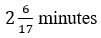
Time = 13 ÷ 221⁄40 = 13 × 40⁄221 = 40⁄17 = 2 6⁄17 minutes → option (c), which prints 2 6⁄17 minutes.
Why the others are wrong
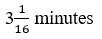
- (a)Option (a) is 3 1⁄16 minutes. At the obstructed rate of 221⁄40 units per minute that delivers about 16.9 units, and the last three minutes add 27 more — roughly 44 units into a 40-unit cistern.
- (b)Option (b) is 9 6⁄7 minutes. The obstructed flow alone would deliver about 54 units in that time, so the cistern would have overflowed before the obstruction was ever removed.
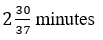
- (d)Option (d) is 2 30⁄37 minutes, which is what you get if the second pipe is read as passing 3⁄8 rather than 3⁄5 of its full flow. The joint obstructed rate becomes 37⁄8 units per minute, and 13 ÷ 37⁄8 = 104⁄37.
Concept
Work-and-time problems are easiest in units. Set the tank to the LCM of the given times, here 40, and each pipe's rate becomes a whole number — 5 and 4 units per minute.
An obstruction that lets through 5⁄8 of the flow scales the rate, not the time, so the first pipe drops from 5 to 25⁄8 units per minute.
The filling then has two phases whose outputs add to the full 40 units. Compute the phase you know completely — the 3 minutes at full flow — subtract it, and the unknown phase is a single division.
The stem asks how long it took before the full flow began, so the answer covers the obstructed phase only.
Adding the 3 clear minutes gives 5 6⁄17 minutes, which answers a different question and is not among the printed options.
Key facts
- Setting the cistern to 40 units, the LCM of 8 and 10, makes the two pipe rates 5 and 4 units per minute.
- An obstruction passing 5⁄8 of the flow multiplies the rate by 5⁄8, giving 25⁄8 units per minute.
- Obstructed, the pair fill 221⁄40 units per minute against 9 units per minute at full flow.
- 3 minutes at full flow deliver 27 of the 40 units, leaving 13 units for the obstructed stretch.
Study next
Common traps
- Scaling the time by 5⁄8 instead of the rate, which inverts the fraction
- Answering with the total filling time, 5 6⁄17 minutes, rather than the obstructed period alone
- Reading 5⁄8 and 3⁄5 as the portions blocked instead of the portions that flowed
SSC builds these as two-phase stems: the pipes run under one condition for an unknown time, the condition changes, and a known stretch finishes the tank.
A version in which one inlet is closed 5 hours before the cistern is full runs at 19 Sep 2024, 16:00, Quant Q.1.
Related PYQs
No directly related past PYQ was found.