
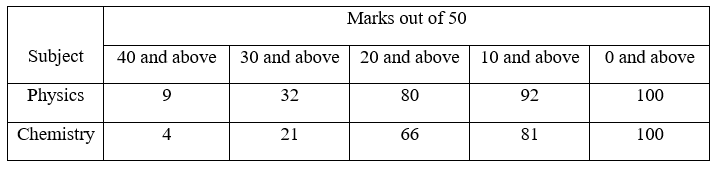
The following table shows the categorisation of 100 students based on their marks in Physics and Chemistry in an examination. If a minimum of 40% marks in Chemistry is required to pursue higher studies in Chemistry, how many students will be eligible to pursue higher studies in Chemistry?
- (a)25
- (b)21
- (c)45
- (d)66
Answer
Why
Correct — D. Turn the percentage into a mark first, then read the right column.
Marks are out of 50, so 40% of 50 = 20 marks.
The table is cumulative — each cell counts everyone at that mark and above.
Chemistry row, column headed 20 and above = 66 students → option (d).
Nothing has to be added, because that 66 already contains the 21 who scored 30 or more and the 4 who scored 40 or more.
Why the others are wrong
- (a)25 — 25 is 21 + 4, the two highest Chemistry cells added as though they were separate bands. The table is cumulative, so the 4 scoring 40 and above are already counted inside the 21.
- (b)21 — 21 is the Chemistry figure for 30 and above, one column to the left. The cut-off here is 40% of 50, which is 20 marks, not 30.
- (c)45 — 45 is 66 − 21, the count of students scoring 20 to 29 only. That band excludes everyone above 30, who clear the 40% bar comfortably.
Concept
This is a cumulative frequency table, not a table of bands. A cell headed 30 and above counts every student at 30 or more, so the columns are nested: 40-and-above sits inside 30-and-above, which sits inside 20-and-above.
Two consequences follow. You never add two cells from the same row, because that double-counts. And the number in a single band is the difference of two adjacent cells, so Chemistry 20 to 29 = 66 − 21 = 45.
The other half of the item is a unit conversion: a percentage cut-off has to be turned into marks against the stated maximum, which is 50 here and not 100.
The Physics row is printed but never used — the question names Chemistry only. Reading 80 from the Physics row instead of 66 from Chemistry is the fastest way to lose this mark.
Both rows end at 100 in the 0-and-above column, which is simply the class size and confirms the table is cumulative.
Key facts
- Marks in this table are out of 50, so a 40% cut-off means 20 marks.
- The Chemistry row reads 4, 21, 66, 81, 100 across the columns 40, 30, 20, 10 and 0 and above.
- 66 students scored 20 and above in Chemistry, so 66 clear the 40% bar.
- In a cumulative table the count in one band equals the difference between two adjacent cells.
Study next
Common traps
- Treating 40% as 40 marks and reading the 40-and-above column, which gives 4
- Adding two cells from the same row when the larger one already contains the smaller
- Reading across the Physics row when the question asks about Chemistry
SSC prints the same five-column, marks-out-of-50 table and varies the subject, the cut-off, or the wording of the eligibility clause.
A near twin — 100 students, English and Mathematics, at least 40% required in Mathematics — runs at 12 Sep 2024, 09:00, Quant Q.12, where the answer is the 65 sitting in the Mathematics 20-and-above cell.
Related PYQs
No directly related past PYQ was found.