
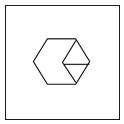
Select the option figure in which the given figure (X) is embedded (rotation is NOT allowed).
- (a)
- (b)
- (c)
- (d)
Answer
Why
Correct — C. Trace figure (X) as one unbroken path first, then hunt for that exact path inside each option.
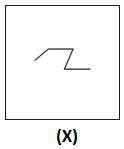
Rule: four segments, in this order and at these angles.
A shallow line rising from left to right,
then a horizontal running right from the top of it,
then a steep line dropping down and slightly to the left,
then a second horizontal running right from the foot of that drop.
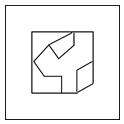
Option (c) carries all four inside its inner square.
The lower edge of the left-hand arrowhead is the shallow rise.
A horizontal runs right from the arrow's tip.
A steep line drops down-left from that horizontal's right end, then a second horizontal runs right.
The arrowhead's upper edge and the short vertical up to the square's top edge are extra strokes crossing the path, which embedding allows.
Measured against (X) the copy is the same size and the same angle, so the no-rotation condition holds.
Why the others are wrong
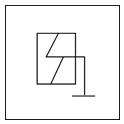
- (a)Option (a) does show two horizontals joined by a drop, but the drop is a vertical line where (X) needs a slant, and its two diagonals are far steeper than (X)'s shallow rise.
- (b)In option (b) the shallow rise runs straight on into a second, steeper diagonal — there is no horizontal at the top of it. In (X) the path turns flat immediately after the rise.
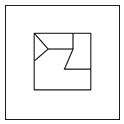
- (d)Option (d) is a hexagon with a triangle across its right half. Its one down-left slant is followed by a horizontal running left, not right, and rotation is not allowed.
Concept
An embedded-figure item asks whether a given path can be laid over part of a larger drawing without moving or turning it.
The efficient method is to reduce (X) to a signature: how many segments, in what order, turning which way. Here the signature is rise, flat, steep drop to the left, flat.
Then scan each option for that signature only. Lines crossing the path do not disqualify an option — camouflage is the whole point of the question — but a missing turn or a changed angle does.
The option figures are pictures, so this card describes them in words. Figure (X) is drawn alone in a box and each option is a filled inner square inside an outer frame.
Key facts
- Figure (X) is one open path of four segments: a shallow rise, a horizontal, a steep drop down-left, then a second horizontal.
- The stem forbids rotation, so any option carrying the shape turned or mirrored is out on orientation alone.
- An embedded copy may be crossed by other lines of the option figure, which is why extra strokes are not a disqualification.
Study next
Common traps
- Matching on general impression. Option (a) reads as the same zigzag at a glance and fails only on the connector.
- Allowing a rotation because everything else fits. The stem rules it out in capitals.
- Abandoning an option because lines cross the path. Only a missing or reshaped segment disqualifies.
The stem is fixed word for word, including the bracketed no-rotation rider, and only the figures change.
Also asked 9 Sep 2024, 16:00, Reasoning Q.6 and 11 Sep 2024, 12:30, Reasoning Q.18, both with the identical stem. Reasoning Q.3 in this sitting carries it as well, so the format is worth drilling until the signature step is automatic.
Related PYQs
No directly related past PYQ was found.