
Identify the figure given in the options which when put in place of ‘?’ will logically complete the series.

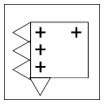
- (a)
- (b)
- (c)
- (d)
Answer
Why
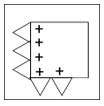
Correct — C.
Rule: one triangle and one plus sign are added at every step, and each element fills its own edge before spilling onto a new one.
Frame 1: 1 triangle on the left edge, 1 plus.
Frame 2: 2 and 2. Frame 3: 3 and 3.
The left edge takes only three triangles. So in frame 4 the fourth triangle hangs below the bottom edge pointing down, while the four plus signs still fit in their single column.
The missing frame therefore needs 5 triangles — three on the left edge, two below the bottom edge — and 5 plus signs, four down the column and the fifth beside the lowest of them.
That is option (c).
Why the others are wrong
- (a)Both counts stall at four. Option (a) shows three triangles on the left, one below the bottom edge and four plus signs — frame 4's totals exactly, with the fourth plus merely relocated to the top right.
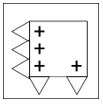
- (b)Five triangles but only four plus signs. Option (b) grows the triangles correctly and leaves the plus count where frame 4 had it, so the two elements stop advancing together.
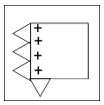
- (d)Frame 4 unchanged. Option (d) repeats three left-hand triangles, one triangle below the bottom edge and four plus signs; nothing has been added at all.
Concept
This is an additive series with a capacity limit. Both elements grow by one each step, but each has a fixed number of places on its own side of the square.
Once a side is full the next element does not squeeze in — it starts on the next side, keeping the same outward orientation. That is why the fourth triangle appears below the square rather than on its left.
So answer in two passes: count the elements to reach the totals the frame needs, then check that they have been placed on the right edges and are pointing the right way.
Key facts
- Both elements grow by exactly one per step: 1, 2, 3, 4 across the given frames, so the answer carries 5.
- The left edge holds at most three triangles, after which they hang below the bottom edge pointing outward.
- The plus signs fill one column from the top down, and the fifth begins a second position beside the lowest.
Study next
Common traps
- Checking the triangles, finding them right, and assuming the plus signs match.
- Expecting the extra triangle to squeeze onto the left edge instead of moving to a new edge.
- Choosing the option that simply repeats the fourth frame.
A near-identical stem runs at Reasoning Q.2 of 17 Sep 2024, 12:30, at 10 Sep 2024, 09:00, Reasoning Q.25 and at 9 Sep 2024, 12:30, Reasoning Q.13.
When a figural series adds elements rather than moving them, the totals settle the answer before any picture has to be compared in detail.
Related PYQs
No directly related past PYQ was found.