
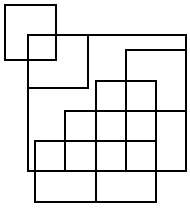
How many squares are there in the given figure?
- (a)20
- (b)17
- (c)19
- (d)18
Answer
Why
Correct — A. Count by size class, never by eye.
Rule: sort the squares by side length, count each size once, then add.
Nine smallest cells. The staircase inside the big outline runs 2 cells across its top row, 3 across the next and 4 across the bottom row: 2 + 3 + 4 = 9.
Seven of double side. Three of them lie wholly inside that staircase; four more are closed off by the stepped outline itself — one at the top right, one on the right, one at the bottom left, one at the bottom centre.
Three at the top left. The two outlines that cross there are squares, and the patch they share is a smaller square in its own right.
One largest. The outer boundary of the whole figure closes on all four sides.
9 + 7 + 3 + 1 = 20 → option (a).
Why the others are wrong
- (b)17 — 17 is the figure without its top-left corner. Count the 9 small cells, the 7 of double side and the outer boundary and you stop at 17 — the two crossing outlines and the square inside their overlap have been left out.
- (c)19 — 19 misses the overlap. Take the 9 small cells, the 7 double ones, the outer boundary and the two crossing outlines, and the only thing still uncounted is the small square the two outlines enclose where they cross.
- (d)18 — 18 drops the two largest ideas at once. It is the 9 small cells plus the 7 double ones plus the two crossing outlines, with neither the outer boundary nor the overlap square counted.
Concept
A composite-square count is an inventory problem, not a spotting problem. Fix a side length, sweep the whole figure for squares of exactly that side, write the number down, then move to the next size.
Two kinds of square hide from a casual scan. One is the square made of several small cells — here every square of double side. The other is the square whose sides are supplied by the outer outline rather than by any drawn cell.
Overlapping outlines add a third kind: the region two outlines share can itself be a square, belonging to neither outline alone.
The figure is drawn freehand. The outer boundary and the two shapes at the top left are close to square on the page rather than exactly square, so measuring with your eye will mislead you.
Judge by structure instead — which four lines close a figure with four roughly equal sides — and the count reaches the 20 the key takes.
Key facts
- A complete n by n grid of unit cells holds n² + (n−1)² + … + 1² squares.
- A staircase is not a complete grid: this 2-3-4 staircase gives 9 unit squares but only 3 squares of double side from its cells alone.
- Squares of double side can also be closed by the outer outline in places where no unit cell is drawn.
- Where two square outlines overlap, the shared patch counts as a square whenever it has four equal sides.
Study next
Common traps
- Counting only the cells you can see drawn and forgetting the squares of double side that span them.
- Missing the small square formed where the two outlines cross at the top left.
- Leaving out the outer boundary, which is a square like any other.
SSC prints this stem verbatim across dates — also at 10 Sep 2024, 09:00, Reasoning Q.14, at 23 Sep 2024, 09:00, Reasoning Q.21 and at 12 Sep 2024, 12:30, Reasoning Q.10, each of these with four close numbers as options.
The options are deliberately adjacent, so a single missed square changes your answer. Write the size classes down; do not hold the running total in your head.
Related PYQs
No directly related past PYQ was found.