
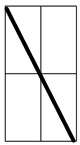
How many triangles are there in the given figure?
- (a)6
- (b)2
- (c)4
- (d)7
Answer
Why
Correct — A. The figure is an upright rectangle cut by three lines: a full-height vertical through the middle, a full-width horizontal through the middle, and a diagonal from the top-left corner to the bottom-right corner. All three pass through the centre.
Rule: count the smallest triangles first, then the ones built by joining them.
Smallest, four of them: the diagonal halves the top-left quarter, and halves the bottom-right quarter.
Largest, two of them: the diagonal cuts the whole rectangle into an upper-right half and a lower-left half.
4 + 2 = 6, option (a).
Why the others are wrong
- (b)2 — 2 counts only the halves the diagonal makes. The two median lines cut those halves again, and four smaller triangles appear in the top-left and bottom-right quarters.
- (c)4 — 4 is the smallest triangles alone. The diagonal also splits the whole rectangle into two large triangles, and both of those count.
- (d)7 — 7 over-counts. Every triangle here needs the diagonal for one side, and the diagonal bounds exactly four small and two large ones — the top-right and bottom-left quarters stay rectangles.
Concept
Triangle counting is a discipline, not a knack. Fix the lines first, then count by size.
The lines here are the four sides, one vertical median, one horizontal median and one diagonal. Only the diagonal is slanted, and a triangle cannot be built from perpendicular lines alone, so every triangle in this figure uses the diagonal.
That reduces the job to asking what the diagonal bounds: two small triangles in the top-left quarter, one on each side of it, two more in the bottom-right quarter, and the two halves of the whole rectangle.
The vertical and the horizontal are both medians, so the diagonal runs exactly through their crossing point.
That is why the two cut quarters split cleanly along their own diagonals rather than being sliced at an angle.
Key facts
- The four smallest triangles are the halves of the top-left and bottom-right quarters, which are rectangles, not squares.
- The two largest are the halves of the whole rectangle, one on each side of the diagonal.
- The top-right and bottom-left quarters contain no triangle at all.
Study next
Common traps
- Counting the top-right and bottom-left quarters as triangles when they are rectangles.
- Stopping at 4 and forgetting the two halves of the whole rectangle.
- Adding a seventh by joining a quarter to the triangle beside it, which makes a four-sided figure.
Triangle counting is set at 09 Sep 2024, 9:00, Reasoning Q.19, at 09 Sep 2024, 12:30, Reasoning Q.1 and at 11 Sep 2024, 9:00, Reasoning Q.3.
Related PYQs
No directly related past PYQ was found.