
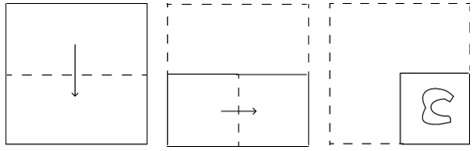
A paper is folded and cut as shown below. How will it appear when unfolded?
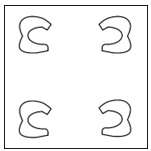
- (a)
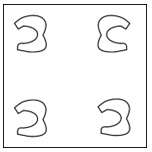
- (b)
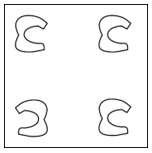
- (c)
- (d)
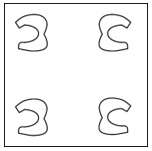
Answer
Why
Correct — D.
Rule: each unfold mirrors the cut across the crease being opened, and a horizontal crease never swaps left for right.
The paper is folded top half down, then left half across to the right, so the cut is made in the packet sitting at the bottom-right quarter. That quarter is never moved by the unfolding, so it must show the shape exactly as the third panel draws it.
Opening the vertical crease puts a left-right mirror of that shape in the bottom-left quarter.
Opening the horizontal crease lifts the whole bottom row upward. A top-to-bottom reflection leaves handedness alone, so the top row repeats the left-right arrangement of the bottom row: mirrored shape on the left, as-cut shape on the right.
Option (d) is the only figure that satisfies all three conditions.
Why the others are wrong
- (a)Option (a) draws the as-cut shape on the left and its mirror on the right. That reverses the whole sheet, including the bottom-right quarter, which neither fold ever moved.
- (b)Option (b) puts a mirrored shape in the bottom-right. The cut was made in that quarter, so it has to match the third panel exactly.
- (c)Option (c) lets its top-left repeat the right-hand shape instead of mirroring it. Opening a horizontal crease copies the row upward and cannot swap left for right.
Concept
Fold-and-cut items are solved backwards. Undo the folds in the reverse of the order they were made, and mirror the cut across each crease as you open it.
Two folds create four quarters, so one cut becomes four marks. The anchor is the quarter the cut was actually made in: it does not move, so whatever the last panel draws is exactly what that quarter shows in the answer.
Each crease also has a direction. A vertical crease swaps left and right and leaves top and bottom alone. A horizontal crease does the reverse.
The four options are near-identical at a glance — the same shape four times in the same four positions, differing only in which copies are mirrored. Working from the anchor quarter is faster and safer than trying to compare all four whole figures.
Key facts
- Two folds give four quarters, so a single cut appears four times when the sheet is opened.
- The quarter that held the cut is untouched by the unfolding and shows the shape exactly as drawn.
- A horizontal crease reflects top and bottom while leaving left and right alone.
- A vertical crease reflects left and right while leaving top and bottom alone.
Study next
Common traps
- Unfolding in the order the folds were made instead of reversing it
- Mirroring the shape in the quarter that never moved
The same fold-and-cut stem is also asked 10 Sep 2024, 09:00, Reasoning Q.23 and 11 Sep 2024, 09:00, Reasoning Q.15 and Q.18.
Related PYQs
No directly related past PYQ was found.