
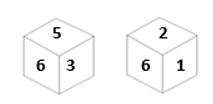
A dice has numbers 1, 2, 3, 5, 6 and 8 on its sides. Two different positions of the same dice are shown below. Select the number that will be on the face opposite to the one having 6.
- (a)3
- (b)2
- (c)8
- (d)1
Answer
Why
Correct — C.
Rule: a face is never opposite anything it is seen beside.
The first view shows 6 on the left with 5 on top and 3 on the right.
The second view shows 6 on the left with 2 on top and 1 on the right.
So 6 shares an edge with 5, 3, 2 and 1 — four of the five other faces. The dice carries 1, 2, 3, 5, 6 and 8, so the only face never seen beside 6 is 8, and it must be the opposite one.
That is option (c).
Why the others are wrong
- (a)3 — 3 is the right-hand face in the first view while 6 is on the left of the same cube, so the two share an edge and cannot be opposite.
- (b)2 — 2 is the top face in the second view with 6 on the left, which makes them adjacent.
- (d)1 — 1 is the right-hand face in the second view, sitting directly beside 6, so it is ruled out too.
Concept
On a cube every face touches four faces and is opposite exactly one. That gives a clean elimination method for two-view dice.
When a number appears in both views, you get to read its neighbours off directly — two from each picture. Four distinct neighbours account for everything except the opposite face, so the answer is whichever number is left over.
No rotation reasoning is needed in that case, which is why spotting the repeated face first is worth the two seconds it costs.
The numbers here are 1, 2, 3, 5, 6 and 8, not a standard 1-to-6 dice. Any habit of assuming opposite faces sum to 7 is useless, and the stem lists the six numbers precisely so you can work out which one is missing from the adjacency list.
Key facts
- Every face of a cube is adjacent to four faces and opposite exactly one.
- 6 appears in both views, so its neighbours read off directly as 5, 3, 2 and 1.
- The six numbers printed on this dice are 1, 2, 3, 5, 6 and 8.
Study next
Common traps
- Assuming opposite faces add to a fixed total when the numbers are not 1 to 6
- Rotating the cube mentally when the repeated 6 already gives the whole adjacency list
The same two-position dice item is also asked 10 Sep 2024, 16:00, Reasoning Q.20 (faces 3, 7, 8, 2, 9 and 4) and 25 Sep 2024, 16:00, Reasoning Q.4 (faces 9, 2, 5, 3, 8 and 6), both asking for the face opposite a named number.
Related PYQs
No directly related past PYQ was found.