
Simplify:
- (a)27
- (b)9
- (c)23
- (d)15
Answer
Why
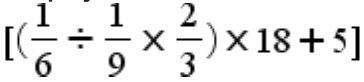
Correct — C. The expression printed is [(1⁄6 ÷ 1⁄9 × 2⁄3) × 18 + 5]. Inside the round bracket ÷ and × rank equally and run left to right, so the division goes first because it is written first.
1⁄6 ÷ 1⁄9 = 1⁄6 × 9 = 3⁄2
3⁄2 × 2⁄3 = 1
Then 1 × 18 = 18
Finally 18 + 5 = 23 → option (c).
Why the others are wrong
- (a)27 — 27 would need the bracket to come out at 11⁄9, since (27 − 5) ÷ 18 = 11⁄9. The chain 1⁄6 ÷ 1⁄9 × 2⁄3 collapses to exactly 1.
- (b)9 — 9 would need the bracket to be 2⁄9, since (9 − 5) ÷ 18 = 2⁄9. But dividing by a fraction smaller than 1 enlarges a number — 1⁄6 ÷ 1⁄9 is already 3⁄2 — and the later ×2⁄3 only brings it back to 1.
- (d)15 — 15 would need the bracket to be 5⁄9, since (15 − 5) ÷ 18 = 5⁄9. Note the + 5 sits outside the ×18: multiply first, add last.
Concept
BODMAS is not six steps but four, because two pairs share a rank.
Division and multiplication rank together and are worked left to right; addition and subtraction likewise. Only brackets and orders (powers, roots) come ahead of them.
The second half of this item is fraction handling: dividing by a fraction is multiplying by its reciprocal, so 1⁄6 ÷ 1⁄9 becomes 1⁄6 × 9⁄1 = 3⁄2. Invert the divisor, never the dividend.
SSC prints the expression as an image rather than as text, so copy it out before working — a misread of which fraction follows the ÷ sign changes the whole chain.
Key facts
- Division and multiplication share one rank in BODMAS and are performed left to right.
- Dividing by a fraction means multiplying by its reciprocal: 1⁄6 ÷ 1⁄9 = 1⁄6 × 9 = 3⁄2.
- The bracket here evaluates to 1, so the expression reduces to 1 × 18 + 5.
Study next
Common traps
- Treating ÷ as ranking below ×, which would evaluate 1⁄9 × 2⁄3 first.
- Inverting the dividend instead of the divisor when turning ÷ into ×.
- Adding the 5 before the ×18 because both sit inside the outer square bracket.
SSC keeps these expressions short and prints them as images, so the marks turn on operator rank rather than on heavy arithmetic.
Comparable simplifications are asked 13 Sep 2024, 16:00, Quant Q.22 (a bare ÷ and × chain with no brackets) and 25 Sep 2024, 12:30, Quant Q.23 (square brackets together with 'of').
Related PYQs
No directly related past PYQ was found.