
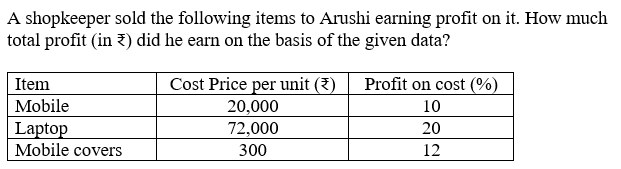
A shopkeeper sold the following items to Arushi earning profit on it. How much total profit (in ₹) did he earn on the basis of the given data? Item → Cost Price per unit (₹) | Profit on cost (%) Mobile — 20,000 | 10 Laptop — 72,000 | 20 Mobile covers — 300 | 12
- (a)34,760
- (b)16,636
- (c)16,760
- (d)16,436
Answer
Why
Correct — D. The table quotes profit on cost, so each row's profit is that percentage of that row's own cost price.
Mobile: 10% of ₹20,000 = ₹2,000
Laptop: 20% of ₹72,000 = ₹14,400
Mobile covers: 12% of ₹300 = ₹36
Add the three: 2,000 + 14,400 = 16,400, and 16,400 + 36 = ₹16,436 → option (d).
Why the others are wrong
- (a)34,760 — The three cost prices total ₹92,300 and the largest rate in the table is 20%, so the profit cannot exceed ₹18,460. ₹34,760 is nearly double that ceiling — an upper-bound check kills it before any multiplication.
- (b)16,636 — ₹16,636 overshoots the correct total by exactly ₹200. Re-multiply all three rows — 2,000, 14,400 and 36 — because a ₹200 drift in any single one of them lands here.
- (c)16,760 — ₹16,760 is 2,000 + 14,400 + 360: the mobile covers taken ten times too large. 12% of ₹300 is ₹36, and the smallest row is where the decimal point slips.
Concept
A percentage means nothing until you name its base. The column here reads 'Profit on cost (%)', so the base of each row is that row's cost price, and profit = cost × rate.
Because every row has its own base, the rates cannot be added and applied once. 10% of 20,000, 20% of 72,000 and 12% of 300 are three separate multiplications; only the three rupee amounts may be added.
Had the column read 'profit on selling price', the same rates would give different rupee answers, because the base would then be the larger number.
The stem is printed as a table with three rows: Mobile, cost ₹20,000, 10%; Laptop, cost ₹72,000, 20%; Mobile covers, cost ₹300, 12%.
The heading says 'Cost Price per unit' but gives no quantities, so each row counts as one unit and the three profits simply add.
Key facts
- When a percentage is quoted on cost, profit = cost price × rate, and the cost price is the base worth 100.
- The three items cost ₹92,300 in total, so at the table's highest rate of 20% the profit could not exceed ₹18,460.
- A 20% profit on ₹72,000 makes the selling price ₹86,400, of which ₹14,400 is the profit itself.
Study next
Common traps
- Reading 'Profit on cost (%)' as a percentage of the selling price, which needs a different base.
- Adding 10 + 20 + 12 and applying 42% to the ₹92,300 total, as though the three rows shared one base.
- Losing a decimal place on the cheap row: 12% of ₹300 is ₹36, not ₹360.
SSC pairs a three-row cost table with a single 'total profit' ask, and hides the marks in the cheapest row rather than in the arithmetic.
Percentage-on-cost reasoning also drives 17 Sep 2024, 09:00, Quant Q.4, where a 20% mark-up followed by a 30% discount ends in a 16% loss.
Related PYQs
No directly related past PYQ was found.