
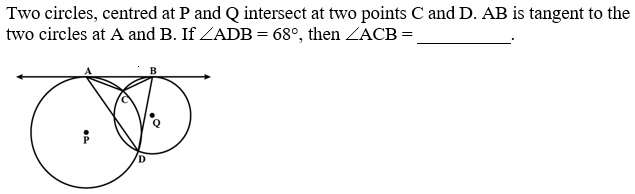
Two circles, centred at P and Q intersect at two points C and D. AB is tangent to the two circles at A and B. If ∠ADB = 68°, then ∠ACB = __________.
- (a)102°
- (b)124°
- (c)132°
- (d)112°
Answer
Why
Correct — D. Rule: the tangent–chord angle equals the angle in the alternate segment. Apply it once in each circle.
Circle centred at P — AB is the tangent at A, AC the chord, so ∠BAC = ∠ADC.
Circle centred at Q — AB is the tangent at B, BC the chord, so ∠ABC = ∠BDC.
Ray DC lies between DA and DB, so adding the two gives:
∠BAC + ∠ABC = ∠ADC + ∠BDC = ∠ADB = 68°
Triangle ACB closes it, since its three angles total 180°:
∠ACB = 180° − 68° = 112° → option (d)
Why the others are wrong
- (a)102° — 102° would leave 78° for ∠BAC + ∠ABC. The alternate-segment pairing pins that sum to ∠ADB, and the question fixes ∠ADB at 68°.
- (b)124° — 124° is 180° − 56°. The subtraction is the right move but the number is misread — the given angle is 68°, so the answer is 180° − 68°.
- (c)132° — 132° would leave only 48° for the two base angles of triangle ACB. Those are fixed at 68° in total by the tangent–chord rule, so 48° is never available.
Concept
Two circles meeting at C and D with a common tangent AB set up two independent alternate-segment relations, one in each circle.
In each circle, the angle between the tangent and a chord from the point of contact equals the inscribed angle that chord subtends in the far segment. Applied at A and at B, the two angles together account for the whole of ∠ADB.
Triangle ACB then finishes the job: its third angle is 180° minus that sum. So in this configuration ∠ACB and ∠ADB are always supplementary, whatever the two radii are.
The diagram puts C between the tangent line and D, which is the case this result is stated for. Read the labels before applying it — swapping C and D swaps the two answers 68° and 112°.
Key facts
- Tangent–chord (alternate segment) theorem: the angle between a tangent and a chord equals the inscribed angle in the alternate segment.
- For two circles meeting at C and D with a common tangent touching at A and B, ∠ACB + ∠ADB = 180°.
- Here ∠ADB = 68°, so ∠ACB = 112°.
- The supplementary result holds for any radii of the two circles.
Study next
Common traps
- Reaching for the tangent–radius right angle, which is true but connects nothing to ∠ADB here.
- Assuming ∠ACB equals ∠ADB because both stand on AB, when they lie in different circles.
- Judging 68° from how the picture is drawn instead of taking it from the statement.
A related two-circle configuration is set at 25 Sep 2024, 12:30, Quant Q.14 — circles meeting at P and Q with PR and PS as diameters of the two circles, asking for ∠PQR.
Both items reward the same habit: name the theorem that links the two circles before touching any number.
Related PYQs
No directly related past PYQ was found.