
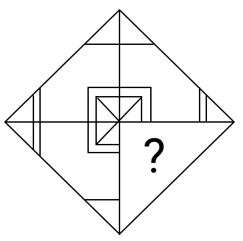
Select the option figure that will replace the question mark (?) in the figure given below to complete the pattern.
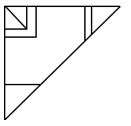
- (a)
- (b)
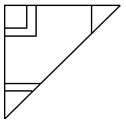
- (c)
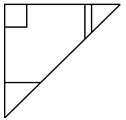
- (d)
Answer
Why
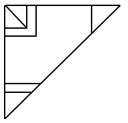
Correct — A. The figure is a square standing on a corner with both of its diagonals drawn, and the piece removed is the bottom-right quarter.
Rule: the figure is symmetric about both drawn diagonals, so the missing quarter is the mirror of the quarters that remain.
Near the left corner, two short chords run parallel to the vertical diagonal and cross into the lower-left quarter. The right corner therefore needs two of them below the horizontal diagonal too.
Near the top corner, one chord runs parallel to the horizontal diagonal. The bottom corner needs one, and its left half is already drawn.
At the centre sit two nested upright squares with an X inside the smaller one. Three arms of that X are drawn, so the missing quarter has to supply the fourth, running from the centre out into the corner.
Option (a) carries all four: two short verticals near the right, one horizontal near the bottom, both nested corners, and the diagonal arm.
Why the others are wrong
- (b)Its corner shows no diagonal arm, which would leave the X at the centre with three arms. It also shows one vertical near the right and two horizontals near the bottom.
- (c)The chords are right, but it drops the outer of the two nested corner squares and the diagonal arm. Just the inner corner is drawn.
- (d)The corner is right, but it shows one vertical near the right and two horizontals near the bottom. That is what a quarter-turn would produce, not a mirror — the left of the figure carries two chords and the top carries one.
Concept
Pattern-completion items hand you a symmetric whole with one piece cut out. The method is to list what the piece must contain, feature by feature, from the parts that remain — not to eyeball four near-identical options.
Here the outline is a square resting on a corner. Both its diagonals are drawn, dividing it into four right triangles, and the bottom-right triangle has been replaced by a question mark.
Every feature appears in mirrored pairs across those diagonals. Chords near the left corner have partners near the right corner. A chord near the top has a partner near the bottom. The centre motif is symmetric in itself.
Build the missing quarter from those pairings first, then match it against the options.
Each wrong figure fails on a single feature rather than on the overall look, and the option figures are drawn in the same orientation the piece occupies in the whole — so no mental rotation is needed, only a careful reconstruction.
Key facts
- The figure is a square standing on a corner with both diagonals drawn.
- Two chords parallel to the vertical diagonal sit near the left corner and two near the right corner.
- One chord parallel to the horizontal diagonal sits near the top corner and one near the bottom.
- The centre carries two nested upright squares with an X inside the smaller one.
Study next
Common traps
- Rotating the missing quarter into place instead of reflecting it, which swaps the chord counts.
- Missing the fourth arm of the centre X because the other three are already drawn.
- Matching on the overall silhouette, which all four option figures share.
The cut-out piece is drawn in the orientation it occupies in the whole figure, so the work is reconstruction rather than rotation. The same task is set at 13 Sep 2024, 12:30, Reasoning Q.13 and at 9 Sep 2024, 16:00, Reasoning Q.10.
Related PYQs
No directly related past PYQ was found.